|

|
|||
|
Portland art blog + news + exhibition reviews + galleries + contemporary northwest art
|
||||




|
Thursday 02.28.19 D.E. May 1952-2019 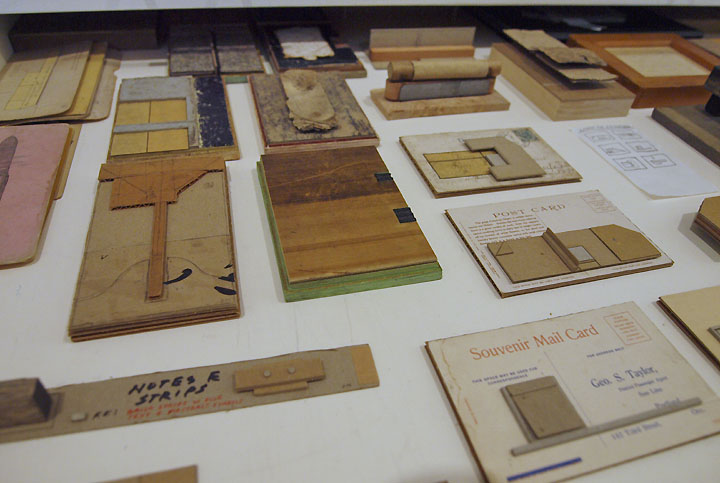 D.E. May drawer at PDX Contemporary (many from his show at LAX Art in 2014) The art ecosystem in Oregon is mourning the death of D. E. May last night. One of our most accomplished and concentrated artists, Dan was an artist's artist with an immense poetic gift for delicate (often paper) materials that had existed previously for other purposes. Dan took their lines and surfaces, pressing them into something like entropic circuit boards that acted like treasure maps for those with an interest in archival ephemera and arcane order. A veteran of Portland's pioneering Jamison/Thomas Gallery Dan became synonymous with JTG almuni gallery, PDX Contemporary, arguably setting the tone for that gallery now known for quiet contemplative work. Gallerist Jane Beebe (JTG then her own gallery PDX) worked with Dan for 35 years and there was something special and nourishing in that relationship. Dan was PDX's pole star and Jane became Dan's favorite ship to run up the rigging and set art to sail on. Where May's work is crucial is how it sits in continuum with the hermetic traditions of art and civilization. Where monks in the middle ages might toil to hand copy books, Dan's work preserved to appreciate all the details that support precision activities. As artifacts they became a residue of the immense concentration and intention he put into the work. This puts him in line with other hermetic materials artists like Paul Klee, Joseph Cornell, Yves Klein and Richard Tuttle. What made his work so refreshing is its stark contrast to the dumpster diving effluence of many contemporary artists today and Dan could do more in 3 inches than many artists that fill warehouses. That succinct aspect of his work was the soul of material eloquence... his work doesnt carpet bomb your senses so much invite you to saturate your senses with sustained attention. One doesnt leave May's work feeling shell shocked, instead I've always felt refreshed from the agency his work bathes the eyes and mind in. His work can be found in some of the world's finest collections and PORT reviewed his excellent exhibition The Template Files at PDX back in 2011. Dan's work is currently on view at PDX Contemporary and on the 4th floor of the Portland Art Museum's Northwest wing. 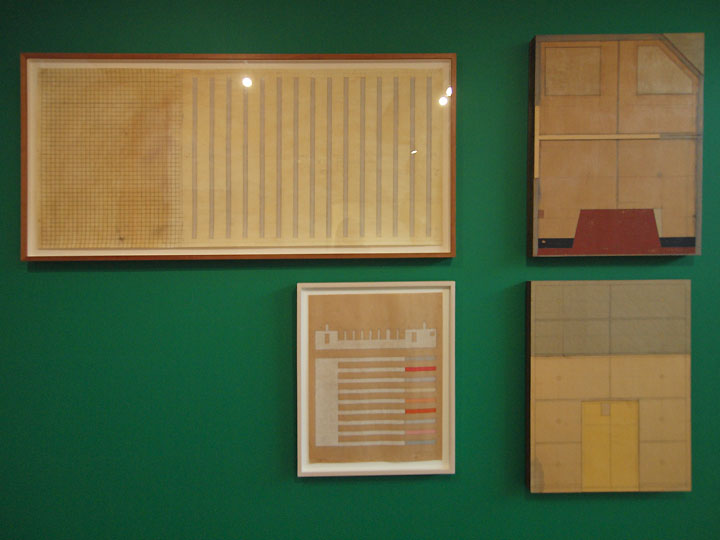 D.E. May currently on display at the Portland Art Museum (more) Posted by Jeff Jahn on February 28, 2019 at 10:40 | Comments (1) PermalinkWednesday 11.09.16 Post Election Art Predictions, Portland Edition 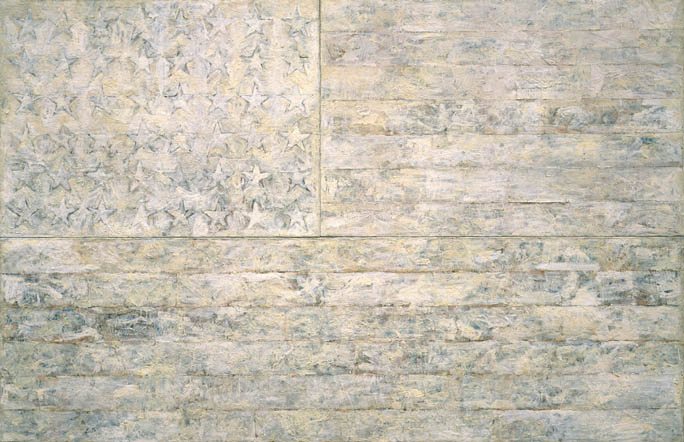 Jasper Johns, White Flag (1955) "I know of no country in which there is so little independence of mind and real freedom of discussion as in America." -Alexis de Tocqueville *note PICA will have a support meetup November 9th from 7-9PM. This wont be terribly popular to all art ears but its time to take stock. Some were shocked by the presidential election last night, others (mostly younger than Baby Boomer voters) were less so but still had a hard time confronting the ugly truths that lead to it. In short, the tenor and shape of liberalism of the past 20+ years was dealt a bit of a death blow and things will be a bit more critical or probing now. In other words the "Art World" will be looking to find its more critical-radical roots and stop being th comfort food of liberal/conservative elites. This will effect art to a point and I expect the art world will find some its lost edge again. Thomas Jefferson famously considered education to be American democracy's biggest Achilles Heel and de Tocqueville has always had the first and last word on our anti-intellectual bias. It looks horrible but we did survive Dick Cheney, and with Trump at least we do know what to look for. Overall, Garrison Keillor's Washington Post piece did a good job but doesn't address the Arts role in this. Basically, cultural capitals like New York, Portland and Los Angeles take on a kind of permissive City State vs anti-intellectual Nation State dynamic, yet to fix things places outside of the city will be key and liberal smugness wont help. That means that culture has to become nimble and more mobile and not just of the city. Portland is on the front lines (good thing Chloe Eudaly will be on City Council). Places like New York, Portland, Seattle and San Francisco are under pressure from markets which have been pricing out artists and galleries. Yet, there still need to be new laboratories of culture that leverage those market pressures to support safe zones for artistic experimentation within city cores. With so much hate there will need to be islands of tolerance where there can be a real fight. It wont be an easy sell for Art. Because of that persistent anti-intellectual bias in the USA those in the Arts and Culture camp have always been on the outside of the mainstream for both parties. Despite this, "culturalists" have a major role to play in the next 4 years in the United States. Why? Because the best art embodies a supple yet razor sharp incisive way of thinking and it is ok to create disagreements over it. The long standing anti-intellectualism needs to find champions of ideas and ideals that Americans can rally around (some may have a start in Art... though Art itself has no answers). I'm talking about the arts helping to inform leaders who can have truly substantial disagreements together, and learn to do so through culture and therefore respectfully disagree... not some forced and false consensus which was the way softer boomer liberalism of the past 20+ years has been. Things will be re-radicalizing and re-intellectualizing and it was inevitable. The arts will become a little more dangerous and less like the pet of the rich it has increasingly become over the past decade or so. Art is like an instrument panel for what is going on in the culture and a gym for minds which require to exercise critical thinking and experiences. Capital "A" Art isnt doctrinaire or zero-sum thinking... in a word it exists because it is nuanced and substantive without being ossified in interpretation. Sadly, the recent election was anything but nuanced. I characterize it as more of a shouting match sneer off, effectively making this about personality without addressing ideals much. It was incredibly parochial and vulgar with one side being a bully and the other doing a "I'm rubber your glue" diatribe. I forgot how bullies usually win those. The only real counter is an instance on a nuanced and questioning approach to life. That nuance is how artists live... no nuance = no Art. Artists are like the physicists and poets of living with stronger and different priorities and they imbue it upon their work in a way that makes those values, ideas, approaches and observations portable. What does it mean for visual art, well there will be a good hard look at liberal ideals and values and a ratcheted up polemic content? Here are some predictions: Anything gilded will be a not so secret code for Trump... the hair of course will be everywhere. ...(more) Posted by Jeff Jahn on November 09, 2016 at 16:40 | Comments (0) PermalinkSunday 04.03.16 Some thoughts on the late Rick Bartow 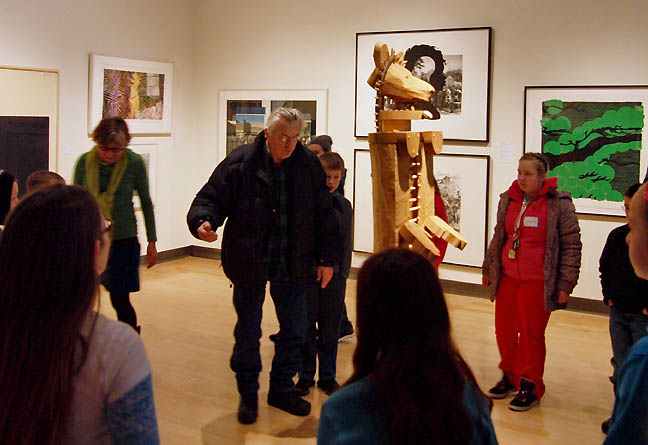 Rick Bartow telling stories and sharing wisdom with youth at Missoula Art Museum We are deeply saddened to report that Rick Bartow passed away yesterday April 2nd. Based in Newport Oregon Rick had grown into the role of the sage, wise old man and as he'd tell you he went about this the hard way. His zootrophical sculptures and 2D works revealed this. In particular his paintings and drawings of birds seemed to speak of the fragility and mortality of life while his bear and wolf sculptures spoke of a kind of continuity in existence.... (more) Posted by Jeff Jahn on April 03, 2016 at 12:03 | Comments (0) PermalinkSunday 12.27.15 Ellsworth Kelly the Universal Naturalist 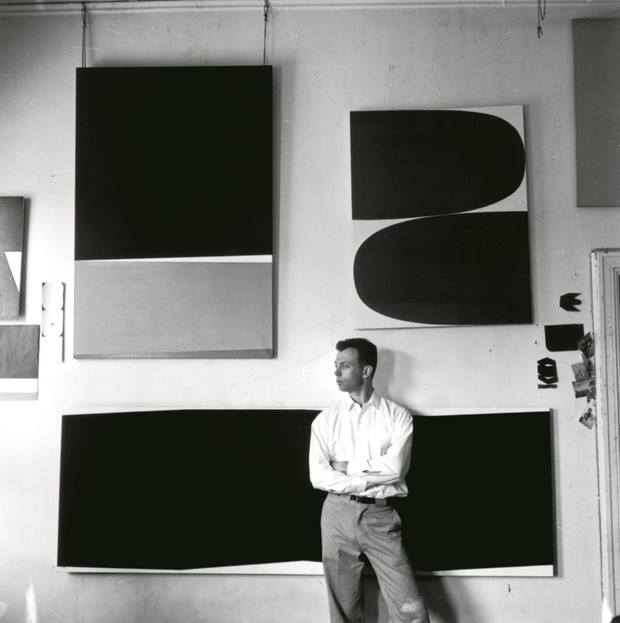 Ellsworth Kelly 1923-2015 "The things I'm interested in have always been there." -Ellsworth Kelly (1967) from Ellsworth Kelly: A Retrospective, ex cat. Solomon R. Guggenheim Museum p.17 We have lost a great one in Ellsworth Kelly as the New York Times, NPR and Guardian report. For so long I have considered him the greatest living painter... and frankly, I don't feel like picking a replacement. For me Ellsworth Kelly is simply the last greatest living painter? Like many over achievers he had a difficult mother, loved to climb trees as a youth (emulating Audubon in observing birds) and was among a group of artists (along with Agnes Martin, James Rosenquist, Robert Indiana & Jasper Johns) that set up their lofts in the cliffs of Lower Manhattan in the 50's. I don't think of him as s figurative or abstract artist so much as a universal naturalist driven by close observation of his environment. Obituaries and essays keep coming in, even a day later. I like these by the Washington Post, LA Times and these by friends like Jerry Saltz & Peter Plagens. ... (more) Posted by Jeff Jahn on December 27, 2015 at 18:20 | Comments (0) PermalinkThursday 12.17.15 2015 top 10 posts by the #'s Well, it is that time of the year again and instead of yet another arbitrary and abbreviated list we at PORT like to start off with sheer unadulterated mathematics.
So, without further ado here is list of our top posts of the year in terms of the eyeballs they have attracted. It is a top 10 for 2015 in no particular order (many are very close to one another) and there are year end surges between now and New Years's eve. (I'll post our full year end survey around January 1 and before that an aggregate review of things we wanted to cover but couldn't fit in). 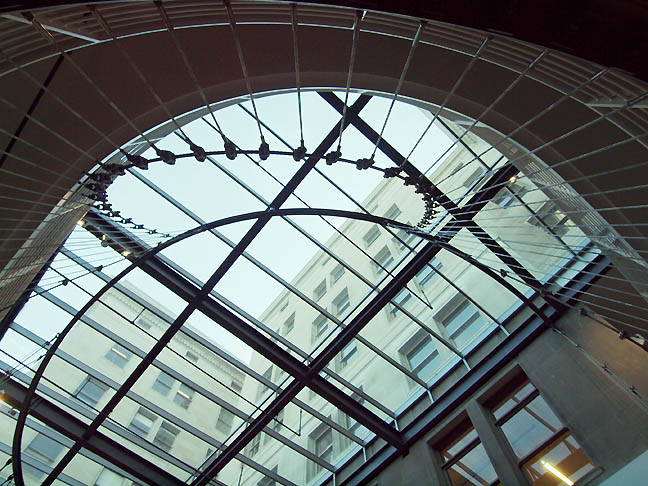 PNCA's massive new skylight and helix-like cable system (all photos Jeff Jahn) The Pacific Northwest College of Art's move to a new headquarters at 511 NW Broadway was the biggest cultural story of the year in Portland and we covered in it two parts. It was rewarding for me personally as PORT was the first media outlet to see the potential for the 511 building and how it could transform the school and city's character. It was heartening to see it all come together and... (more) Posted by Jeff Jahn on December 17, 2015 at 11:54 | Comments (0) PermalinkSaturday 10.10.15 Seeing Nature at PAM 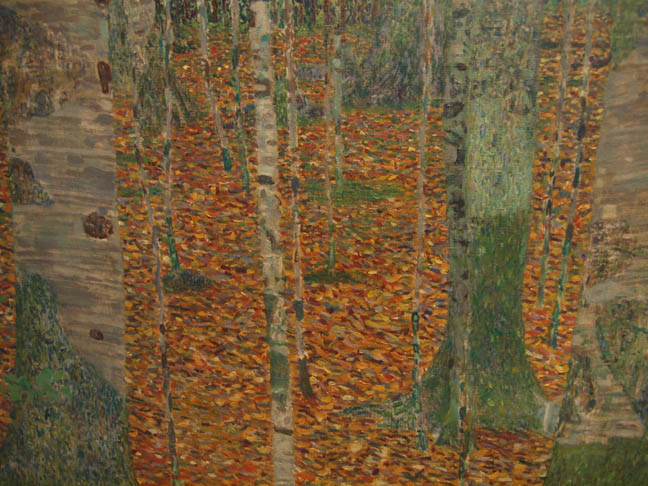
Detail of Gustav Kimt's Birchenwald (1903) at PAM (all photos Jeff Jahn) Today, Seeing Nature drawn from Paul Allen's collection opens to the general public at the Portland Art Museum. The traveling exhibition originated with PAM in conjunction with the Seattle Art Museum is a kind of survey of landscape paintings throughout history and as such maps the shifting expectations that viewers have for looking at what we consider the outdoors. One thing I very much like about the exhibition is the way it treats cityscapes as a part of nature and the landscape, thus to "See Nature" we have to see our own role in it..... (more) Posted by Jeff Jahn on October 10, 2015 at 12:01 | Comments (0) PermalinkTuesday 06.30.15 PORT is 10  This June marked PORT's tenth anniversary and with over 3,000 posts (2500comments) and a whopping 1.5 million+ unique readers in 2014 alone we are Portland's most critically attuned and comprehensively perceptive visual art website, period. We didn't want to dwell on that so instead we will make our 10 year a bit of a case study on the role of criticism and the way it interfaces with the visual arts ecosystem (here is a primer, a much longer essay is coming your way). Part of our role is to counter those Very Portland passive aggressive tendencies, while giving scope and scale to an Eutrophicated art scene with far more activity than any city this size should normally have. We do this by taking a position while acknowledging other ones in doing so. Art critics are incredibly rare and it goes without saying but 10 years on the internet is like living to 100 in human years. We bet you wonder what you think about news today? Well its coming (we are the only outlet with enough experience to unpack it locally), and yes the Guenther piece is coming for your post holiday summer reading. It discusses way more than Bruce's time at PAM, pivoting to a discussion of the way curatorial roles have been shifting all along. Nice timing eh? Way back in 2007 we helped lead the online art discussion in Art In America and this year I want to re-open that can of worms in a revealing way that presents an anatomy of criticism's evolution. Wait till you see what we've got coming, including a hard publication, high level events (partnering with some of our sponsors), site redesign, + great interviews, deep historical analysis and bespoke reviews with "teeth"... the kind that reach far beyond the Pacific Northwest. Our reviews mean something because we don't judge things by the local or even current art world standards, we compare against relevant models (often historical) even in other disciplines. Portland isn't good at assessing scale and scope, and that's PORT's specialty. It goes without saying that if there's a big story, people seek out what we think. One example would be ... (more) Posted by Jeff Jahn on June 30, 2015 at 12:58 | Comments (2) PermalinkWednesday 07.16.14 Next Wave 2014: New Faces In The Portland Art Scene A healthy art scene identifies and welcomes new talent but we should also be keeping an eye out for new presenters, who often have the hardest job of all... that of not only opening new doors... but also keeping them open.
At PORT, we take seriously the role of identifying new talent early on... not simply jumping on a bandwagon after new artists and spaces are established (but I also want to see if there is staying power). Thus, it is time for another installment of our New Faces series, focusing on new leaders to the art scene because it is precisely these early beginnings where being a talent scout can do some good. Every few years we seem to have a sea change where some familiar spaces shut down (in the last few years it was Worksound, Place and Appendix) and it leaves holes which some enterprising new faces seek to fill (Place was forced to transition to Surplus Space and both Adams and Ollman and Upfor Contemporary have added to the gallery scene but what gets me up in the morning are discovering what those "wildcard", unproven new personalities might accomplish). Although nobody is doing anything the size (ie a large industrial space) and the consistently international scope of Worksound it looks like there is definitely a new crop in the works. 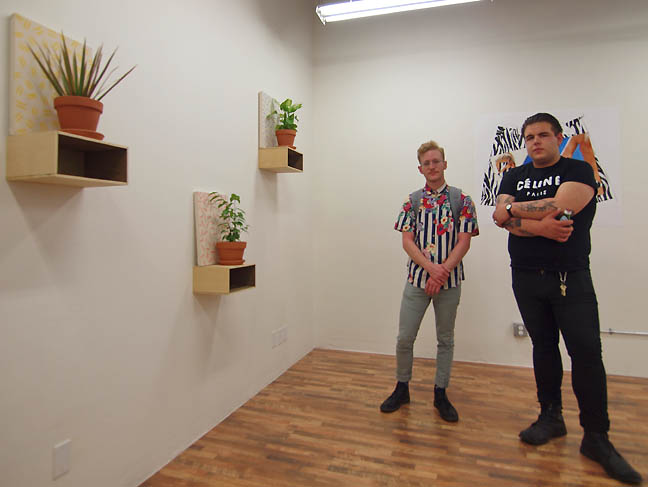 HQ Objective is (L to R) Johnny Ray Alt and Andre C Filipek In April 2014 Andre C Filipek and Johnny Ray Alt inaugurated the HQ Objective's project space, titled HQHQ (think HQ squared) in the depths of the venerable Oak Street Building in the heart of Portland's Central Eastside Industrial District. It is an industrial neighborhood where so many alternative spaces and warehouse shows have taken place but HQHQ with its faux wood floors make it feels far more more polished than previous efforts. Filipek and Alt are both recent PNCA grads with an aesthetic reminiscent of the now shuttered Appendix Project Space. What's different is a somewhat more design-y and an early international outlook they have taken, including an artist from the UK in their May show. Definitely a space to keep one's eyes on. HQHQ 232 SE Oak St. #108 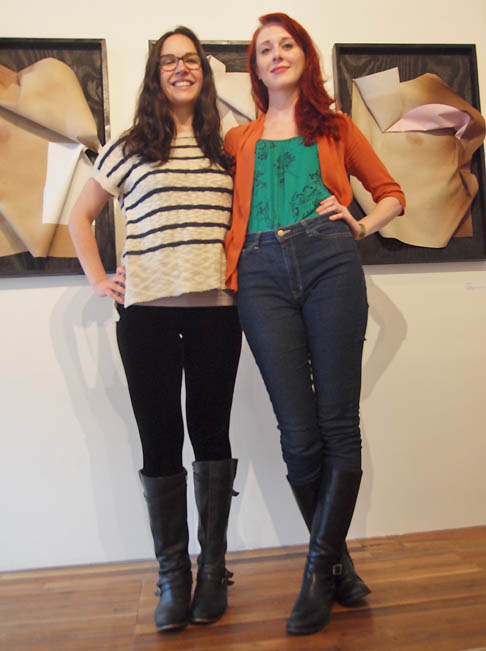 Lindsay Jordan Kretchun and Jessica Breedlove Latham at Duplex Collective Duplex is another art and design minded alternative space headed by the whipsmart duo of Lindsay Jordan Kretchun and Jessica Breedlove Latham. ...(more, C3: initiative, Hap & Muscle beach ) Posted by Jeff Jahn on July 16, 2014 at 15:11 | Comments (0) PermalinkThursday 06.19.14 Distinguishing Wolves & Coyotes  Wolf, voor de natuur, Saxifraga - Jan Nijendijk.5097 Two must read writings this week by two different critics seem to be pointing in a similar direction, namely the one where critical thinking goes beyond simply creating "dialog" and takes a harder nosed approach. Jerry Saltz's exegesis on "Zombie Formalism" or "Crapstraction" levies full critical weight on the shruggy gesturing work we see everywhere from Portland to New York City. No scene is immune. Personally I'm proud to have pissed off plenty of dilettante tin-eyed zombie Greenbergs who want to believe that drop cloth or tarp paintings are anything but predictable rehashings of the late 60's and early 70's rendered with a very slight emo twinge of failure mongering and self pity. ... (more) Posted by Jeff Jahn on June 19, 2014 at 16:31 | Comments (0) PermalinkThursday 06.05.14 Nine Years of PORT This June marks PORT's ninth anniversary and fittingly this is our 3,000th post as Portland's most critically attuned and comprehensively in depth delving visual art website. It has always been a group effort as this early interview in the Mercury from 2005 can attest. I'm planning a site revamp and a retrospective publication for our tenth (next) year. We have practiced the way we preach about how persistence and follow through matter. Overall, critical writing about visual art is incredibly hard and I've always likened PORT as a confederacy rather than the old news room model, which makes sense since criticism and journalism have never been a natural fit. Instead, we have always placed a premium on critical thinking rather than simple reportage (or community mongering)... mostly because PORT is a trade journal devoted to hard core visual art and design geeks. I've always seen it as a first draft of history as it happens and the internet allows us the speed and ability to edit the inevitable grammar gaffs that working without an formal editor creates (we do edit the interviews). As a rule it's easy to separate the bad from the good... it takes something more to give those unsatisfied with the merely good enough feedback to reach a bit higher. It also makes our reviews matter. Not all blogs are the same (PORT bears very little comparison with most) but I feel it is our dogged focus on just a few things like critical in depth thinking on visual art and design (usually with a civic icon-like status) that has kept us... (more) Posted by Jeff Jahn on June 05, 2014 at 14:19 | Comments (0) PermalinkTuesday 04.29.14 Reacting to Serra 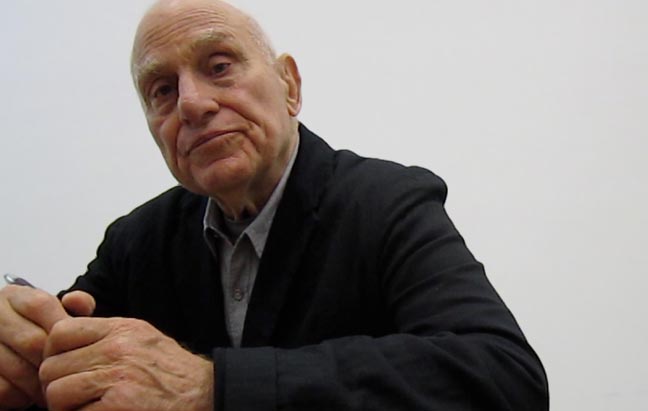 Richard Serra (photo Paul Middendorf) Many will react to Richard Serra's diatribe last night as just another old man talking about how he had to walk 25 miles in the snow in order to get some lead to melt and throw in a corner. That would be a mistake though. I've always found Serra to be very thoughtful and persuasive. He's very deliberate and forms his thoughts cautiously when you speak to him.... he also takes stock of you. That and he's arguably the world's greatest sculptor and is still making work at the top of his game. In particular, his emphasis on there needing to be a marginalized subculture has my attention. It echoes Degas' view that an artist creates for only a few people within their immediate circle. I feel he is right... (more) Posted by Jeff Jahn on April 29, 2014 at 13:42 | Comments (0) PermalinkFriday 04.11.14 Thoughts on Sigmar Polke 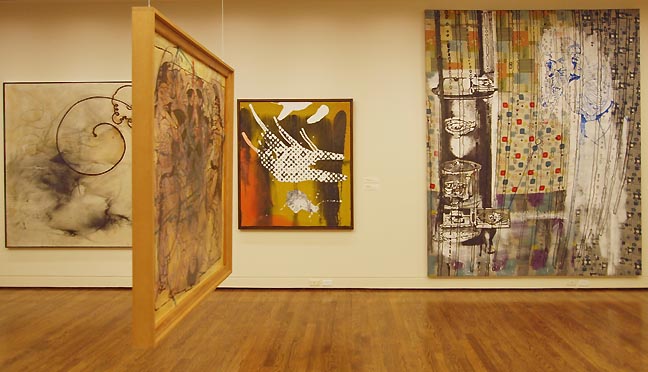 Works by Sigmar Polke from the Nicolas Berggruen Charitable Trust on display at the Portland Art Museum in 2013 (L to R) Providentia-Schleife (1986), Untitled (1989), Druckfehler (1986), Lumpy Hinter dem Ofen (1983), Untitled (1983), photo Jeff Jahn With the opening of Sigmar Polke's retrospective, Alibis at MoMA, there has been a sudden and massive interest in his work. PAM had a wonderful and very strong exhibition of Polke's work last year (which Victor reviewed), including a couple of key works in the Polke retrospective. Polke's work has always left me conflicted. Back in the 80's and early 90's you couldn't take in a major museum without confronting one or two of his works, each generally very different from the last. It was incongruous work that reveled in its own capricious quality that dealt in the seams of various pastiches while being exhaustively inventive in its general dolor. That wasn't a bad thing. It was a lot like a less hopeful version of Rauschenberg's quilts of material and imagery but suffused with a German cynicism of history that isn't present in the major American work that preceded it... (more) Posted by Jeff Jahn on April 11, 2014 at 10:24 | Comments (0) PermalinkTuesday 04.01.14 15 Years in Portland 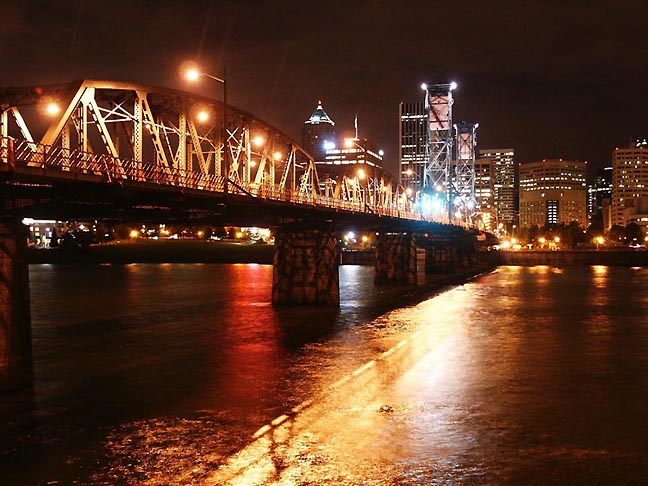 Photo Jeff Jahn Today marks the 15th anniversary of my moving to Portland. I chose this place because there was already an art scene but it seemed like Portland was ready for much more. Also, on the West Coast culture is a growth industry. In general, Portlanders are passionate and driven people who have chosen this place for moral not economic reasons. Back in the early aughts many who had lived here for a while didn't think it was possible for Portland to be something other than a remote place where people went to avoid the rest of the world. They were quite simply, wrong. Now the world increasingly comes here and it isn't uncommon for an artist to have a national/international career showing at major venues. That said most of our larger institutions have not been crucial in facilitating that kind of export career and it is something to work on, even though there has been some headway made like the Precipice Fund. Also, many old school Portlanders who are hold overs from before "the revolution" of 2001-2003 have a difficult time addressing greatness/ambition within Portland's city limits... for example, Mark Rothko (where PAM really stepped up), Robert Colescott, the details of PCVA's programming and the city's very active alternative spaces still don't get the respect/civic ownership deserved somehow because they ceased or are transient in nature. That very serious snark aside, I've been very lucky that Portland and its citizens have been so supportive of a role that is both of Portland and also acts as a go between for the rest of the world. To celebrate the anniversary (or for some, their chagrin) this April is chok full of events where I'll be making appearances as Portland's most visible curator/critic combo. For starters a panel discussion on challenging art and Clement Greenberg on April 19th, 2PM at Blackfish Gallery for their 35th anniversay and I am guest curating OPB's State of Wonder radio program on April 26, where I'll reveal a few new projects I've been working on. Other announcements, essays, interviews etc will take place throughout the month (including the trailer for my first movie, Cardenio on the 26th) and the beginning of PORT's series of pieces on contemporary patrons who are actually patrons, not just market speculators. There will also be an essay on art criticism posted before the talk on the 19th but this short piece on the subject is a good preview. Like a lot of Gen X, Y and Millennials I chose Portland because the city had a more granular non-corporate civic character. This character makes it porous to people who want to make a mark based on merit rather than resume or market capitalization. Portland was a ... (more) Posted by Jeff Jahn on April 01, 2014 at 17:26 | Comments (0) PermalinkTuesday 03.11.14 Guggenheim Mural Restoration )
Pollock's famous Guggenheim Mural has undergone a restoration and the Getty has released a fascinating video regarding the work. I saw the work on display at the Des Moines Art Center and discussed it a little with their Director here. I'm uncertain how I feel about the shaped canvas solution the Getty chose but it surely does address the odd issue of revealed unpainted areas due to distortion that were very notable when I saw it. It gave the painting an odd "artifact" of history aspect that bothered me. Generally, I prefer a painting be a present presence where I'm less aware of restorations. This is doubly true because it is a mural and I agree in principle with Christopher Knight who wrote yesterday on his feeling that it is installed wrong now. At the Des Moines Art Center it was displayed in a room with lower ceilings and the compression emphasizes field of view horizontal aspects to much greater effect than the Getty's hang now does. Still, the problem with the Getty's hang isn't the distance from the floor as much as the immense height of the gallery. As Knight pointed out it undermines its best qualities as a space shaping/filling mural. 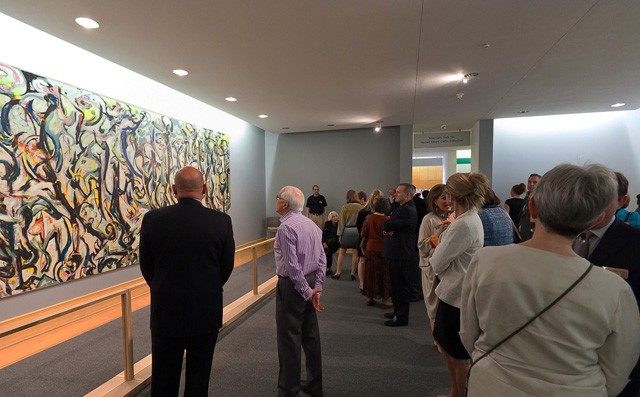 Jackson Pollock's Guggenheim Mural on display at Des Moines Art Center (2012) It is fascinating and very important that the painting is now proven to be a multi-layered and multi-stepped undertaking, not a project completed in a single furious exegesis of paint applied in one session. That makes sense and it furthers Pollock's reputation as an intentional innovator... not someone who simply got lucky when under the gun... (more) Posted by Jeff Jahn on March 11, 2014 at 9:56 | Comments (0) PermalinkFriday 02.14.14 Art Couples The history of the visual arts is littered with significant couples. True, Donald Judd and Yayoi Kusama dated a bit but one could see why that would never last. Frankly, any time a particularly driven person (like a serious artist) is in a relationship it becomes a complicated situation... sometimes more so when it is two artists.
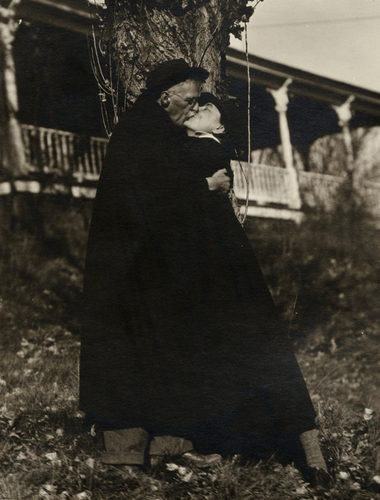 Steiglitz & O'Keefe, Yale Collection of American Literature, Beinecke Rare Book and Manuscript Library Some relationships are more complicated than other and perhaps Alfred Stieglitz and Georgia O'Keefe are my all time favorite. NPR did an in depth post on their history here. What I find so interesting was the way they were soul mates more than anything else. They didn't even need to be near each other. The Jackson Pollock / Lee Krasner marriage was similarly complicated but far more volatile with Pollock being a bit of an incomplete adult trying to fill in psychic holes. Still, it is pretty safe to say there never would have been a Pollock without a Krasner. She certainly steadied him and helped focus his thinking. Her own aesthetic discoveries were buried at first to make his seem more like an act of isolated genius. It reminds me of... (more) Posted by Jeff Jahn on February 14, 2014 at 13:53 | Comments (1) PermalinkMonday 01.20.14 The Fail Gallerist Edward Winkleman has a great post on young artists and how seriously they approach their next show... and the difference between being an art star and a rock star. It is also about how shows fail and my sense is that it is always "both" the gallery and artist who fail in their understanding of one another. This results in a massive dud of an exhibition because neither side understands their own position in relation to the other (which is what really matters). Of course both will usually try to distract blame away from themselves but at the root is a kind of dysfunctional collaboration. For non profit shows the situation works the same...
Ed's take (as always) is very New York centric, cogent and makes a point about the necessary game of self-deluding that most young (and old) artists make about their lifestyle choices but it applies to Portland as well. 
It really applies to any place with a scene, i.e. somewhere where enough artists and other art world resources have congregated so that a "Community of Desire" as Dave Hickey calls them in his essay My Weimar are capable of creating an ecosystem where peer review and audience are generated. The professional critics are both... (more) Posted by Jeff Jahn on January 20, 2014 at 10:00 | Comments (0) PermalinkFriday 12.20.13 Bacon triptych now on display at PAM 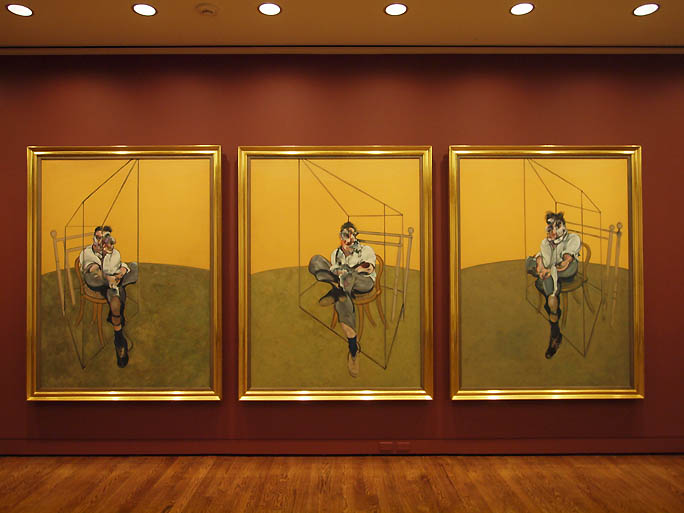 Three Studies of Lucian Freud (1969) installed at PAM (photo Jeff Jahn) Well, gawkers and serious art fans alike... it is now on display, Francis Bacon's Three Studies of Lucian Freud triptych, as you can see in this exclusive photo (taken just after it was hung but before the small metal foot barrier was put in place). Some will see this as an art market apocalypse and treat it in much the same way celebrity weddings or major car crashes are covered but be assured we will treat it for what it is, a serious piece of art and yes you should go see it. Seeing it on display at PAM it looks like there wont be an annoying line where you are queued up like some amusement park ride. Besides, Bacon was completely unlike Rothko, who would have abhorred all of this attention and speculation. In fact, Francis Bacon thrived on all of the drama and I see it as keeping the spirit of his work alive (obscene and elegant at the same time).... (more) Posted by Jeff Jahn on December 20, 2013 at 16:52 | Comments (1) PermalinkTuesday 07.09.13 A cursory arts journalism/criticism discussion Two prominent bloggers, Edward Winkleman and Tyler Green discuss the changing nature of visual art journalism in this worthwhile read. They are also fellow alumni of the 2007 Art in America roundtable on the changing face of digital arts writing.
I agree with Tyler most on one particular part, so much of what is written has become art market reportage and I've noticed that in general Americans have become even less interested in critical thinking than they were in the 80's (which weren't exactly the 40's-60's). Visual art writing has become mostly a brochure for art as product (a restatement of the artist's intent and an expository traveler's report) because that is what the art dealers and auction houses want. Perhaps that is why I've always taken a more British/argumentative approach of probing or testing assumptions and trying to compare the intent vs. outcomes, while expanding the frame of the discussion. I did get my start writing for Modern Painters magazine when it was London based and arguably the best art magazine of the 90's till the early aughts. Later it was sold and moved to NYC. In short, I simply don't write ad copy that masquerades as a critical review and I push PORT's other writers to do the same (even for announcements we prefer a little critical edge). Overall, the discussion of the market creates a bubble-like complacency that I find disturbing... (more) Posted by Jeff Jahn on July 09, 2013 at 10:44 | Comments (0) PermalinkSaturday 06.01.13 Eight Years of PORT It is hard to believe, but June marks PORT's 8th anniversary as Portland's most fearlessly critical and in depth source of visual arts discourse and information. We've gone from those early days in 2005, when people wondered if the internet was even an effective place for art criticism... to 2007 with notice from the Walker Art Center and an Art in America Round Table. For 2012 alone we boasted over 1.3 million unique readers and a nod from the Wall Street Journal. One of the things I'm most proud of is the way the site has allowed a group of writers to articulate themselves as a variety of strong voices and we have interviewed the likes of Catherine Opie, Ed Ruscha, Ai Wei Wei, Okwui Enwezor, Richard Serra and Critical Art Ensemble (just last month). What's more we have a backbone, noted for independent critical analysis of institutions and regional tropes and are often first to point out major turning points like PNCA's eventually successful bid for the 511 building or OCAC's new Vollum Center. We often break stories, like the Portland Art Museum's new identity and PICA's Precipice Fund. Criticism isn't simply a description or a parroting back of the artist's statement, which does nothing to improve the state of the arts. Instead, we ask difficult questions and pursue an understanding of the way art operates and comes into being. Ultimately, it is this commitment to defining and relevant reviews + essays that are at the heart of what we do. Here are ten examples that that celebrate what PORT does: Storm Tharp 2007 William Kentridge 2007 Rothko's Portland 2009 Alfredo Jaar and Carsten Holler 2011 No Painting Left Behind 2011 Interior Margins 2012 Folkert de Jong 2013 We pay especially close attention to developing artists like Travis Fitzgerald and Gary Robbins or Chase Biado because criticism brings feedback at a crucial time. There is something about criticism that makes the discussion broader, more present and sharper for everyone. Criticism, especially that with a finer edge actually can motivate discussion. That type of true criticism is inherently inconvenient and perhaps the best corrective to the constant packaging and pure public relations that even art is subject too. Criticism helps us step back from ourselves and re-examine our priorities and experiences through a different understanding. A "Critic" brings experience beyond opinion, often sussing out the more arcane motivations and effects of art. It all takes time... in the case of PORT (a community of writers) it takes 8 years. Posted by Jeff Jahn on June 01, 2013 at 22:01 | Comments (0) PermalinkThursday 02.14.13 Jean Michel Basquiat Valentine 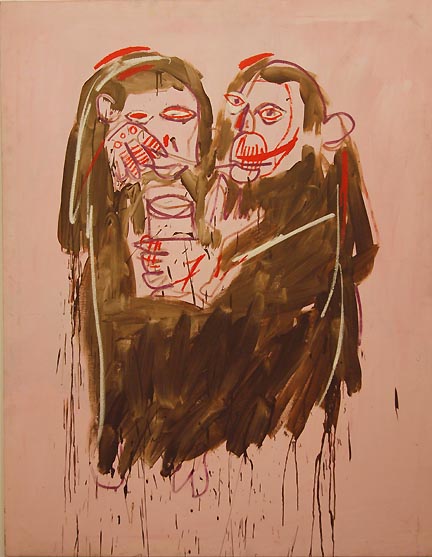 Jean-Michel Basquiat, Valentine (1983) Long term loan of Paige Powell at Portland Art Museum (Jubitz Center 3rd floor) Just wishing PORT's readers a Happy Valentine's Day with this very unique Jean-Michel Basquiat on display at the Portland Art Museum as an interesting and nearly inscruitable meditation on relationships. It is one of the most unique Basquiats I've ever seen. It is a seemingly inward and private painting, portraying two monkeys grooming each other awash in a gentle field of pink. The figures are rendered with an intense roughness that offsets the saccharine color field and heart shape that their forms create. ...(more) Posted by Jeff Jahn on February 14, 2013 at 16:08 | Comments (0) PermalinkThursday 12.06.12 A Seat At The Table? Considering Soft Power: MK Guth and Mark Smith "Only through art can we emerge from ourselves and know what another person sees" -Marcel Proust
Proust is utterly wrong with that quote of course, but it is a sentiment of yearning and perhaps a tad religious one at that. Instead, Art tends to be as subjective as anything else... though visiting someone's home or having a meal together is a kind of shared experience that is similar to looking at art or a performance together. In fact, all meals are performances and there is a power in such communion. The point being that art doesn't have any special authority, only that it has license to make unexpected demands on those that experience it. Sometime between the time of Lascaux and Titian though, art experiences became increasingly elitist and about projecting power. This was the hard power of class authority or social station. 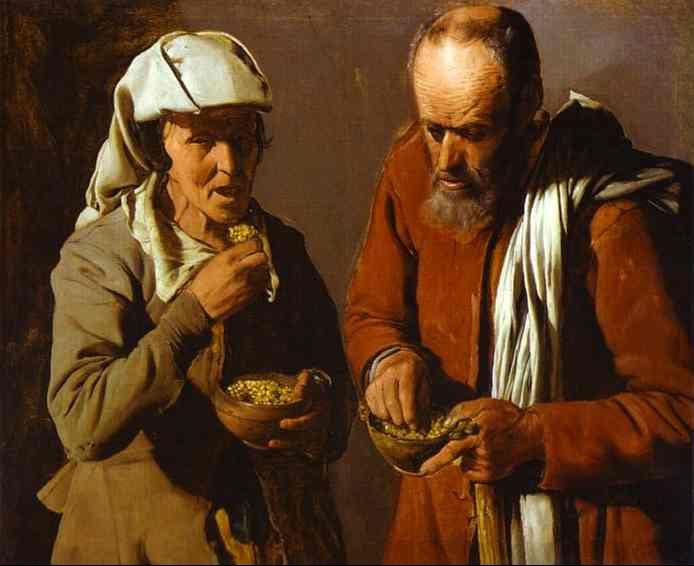
Georges de La Tour, Porridge Eaters (1625) In the 1600's a painter by the name of Georges de La Tour broke from the traditional baroque painting subjects like academic history scenes (history through the lens of those in power) and patron portraits to focus on genre scenes of commoners at work and play. Rather than using the image to project authority or hard power in an icon it projected a pervasive or soft power of secular domestic life and simple everyday pursuits. ...(more) Posted by Jeff Jahn on December 06, 2012 at 13:17 | Comments (0) PermalinkFriday 08.17.12 Gerhard Richter at PAM 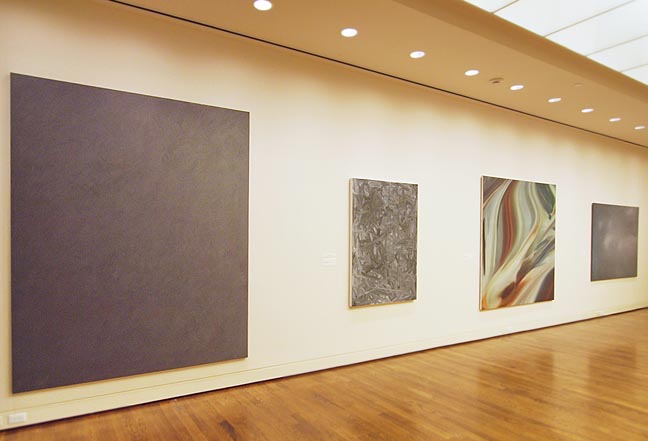 Seven Works by Gerhard Richter at PAM, Grau (Grey) on the left (All works on Loan from the Nicholas Berggruen Charitable Trust) Currently on view at the Portland Art Museum are Seven Works by the German painter Gerhard Richter, on loan from the Nicholas Berggruen Charitable Trust. The works are often monochromes, the most spectacular of which is Grau (Gray). ... (more) Posted by Arcy Douglass on August 17, 2012 at 10:40 | Comments (10) PermalinkThursday 07.19.12 Priming the Cultural Pump: Rethinking Portland's Relationship with the Arts 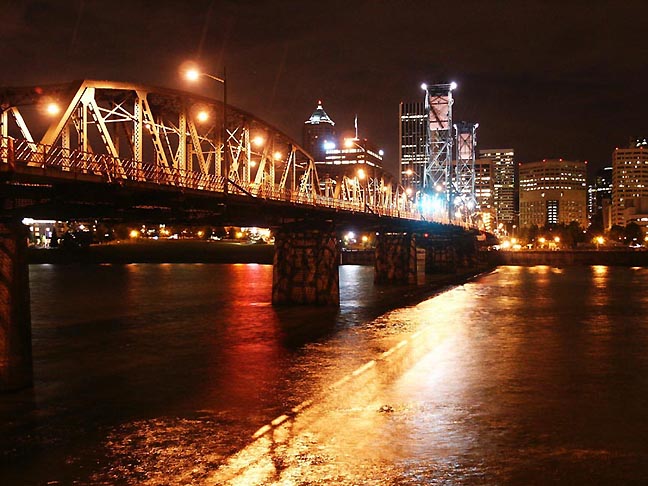 Last January I authored an OP Ed piece on Portland's somewhat troubled relationship with supporting internationally notable levels of excellence with special focus on the arts. Before tonight's town hall style panel discussion on the subject I'd like to dig a little further. First of all, it is an indisputable fact that the artists who have been flooding into Portland since at least 1999 (often educated outside of Portland) have changed the expectations and awareness of the city as an interesting art city worthy of international attention. Now the New York Times stalks Portland for its edgy funky charm... they never quite get it that it is the permissive arts atmosphere. It all started when the 1999 Oregon Biennial shocked people with multimedia work. In 2002 I staged a show called Play to show just how different things had become and in 2003 a series of large warehouse shows Beamsplitters, The Best Coast, The Modern Zoo, Core Sample and Battle of the Artist Curators all hammered the point home. Portland has been interesting for at least 13 years now but... ...(more) Posted by Jeff Jahn on July 19, 2012 at 18:05 | Comments (2) PermalinkMonday 05.28.12 Final Thoughts on Rothko 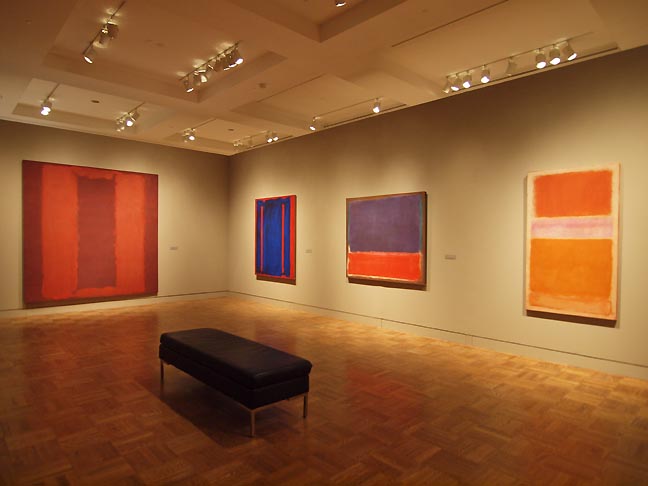
Mark Rothko retrospective at the Portland Art Museum (all photos Jeff Jahn) It is the last day for the Rothko Retrospective at the Portland Art Museum and though I've written on the Rothko retrospective frequently, and discussed on OPB's Think Out Loud radio program, even taught a seminar on the subject... it never becomes exhausted. Though it is a very main line even predictable retrospective....read that as a Christopher Rothko style focus on the singular stylistic development achievements rather than a more complicated look at how artists and other thinkers like Miro, Matisse, Milton Avery, Adolf Gottlieb and Clyfford Still all played a part in his still singular breakthrough, it is arguably the most important show the Portland Art Museum has put since Rothko's first solo show in 1933 at that same institution. You should see it right now if you haven't already.... (more) Posted by Jeff Jahn on May 28, 2012 at 12:47 | Comments (0) PermalinkFriday 03.23.12 Free hours and an Avery depiction of Rothko First of all, everyone in Portland should know that tonight from
5-8 PM the Portland Art Museum will be open free of charge. It's a lovely
day and likely a lovely night out on the town to check out the Rothko Retrospective,
Joseph Beuys, John Frame etc. What's more the Portland Art Museum has more Rothko
on display than already advertised (I know how is that possible?).
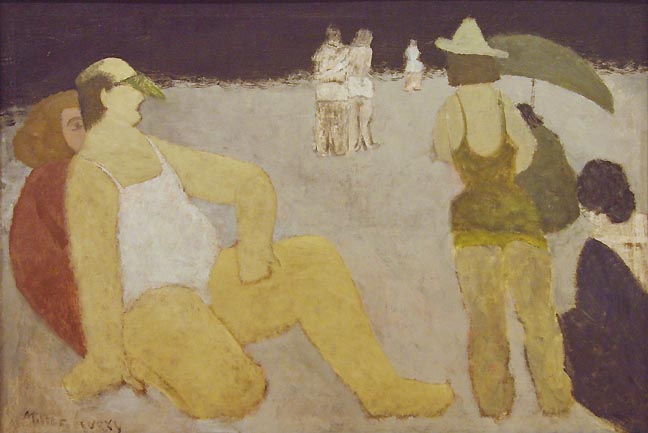 Milton Avery, Bathers Coney Island (1934) in the Portland Art Museum's collection Here is how... ever since I moved to Portland in 1999 I noticed a rather striking Milton Avery in PAM's collection called Bathers, Coney Island (1934). It is a good painting for an Avery beach scene, which are generally not regarded as highly as a more formal Avery portrait or landscape. regardless, what instantly got my attention was the large figure in the foreground with a green visor. Posted by Jeff Jahn on March 23, 2012 at 13:12 | Comments (0) PermalinkWednesday 02.29.12 Portland's relationship to Rothko 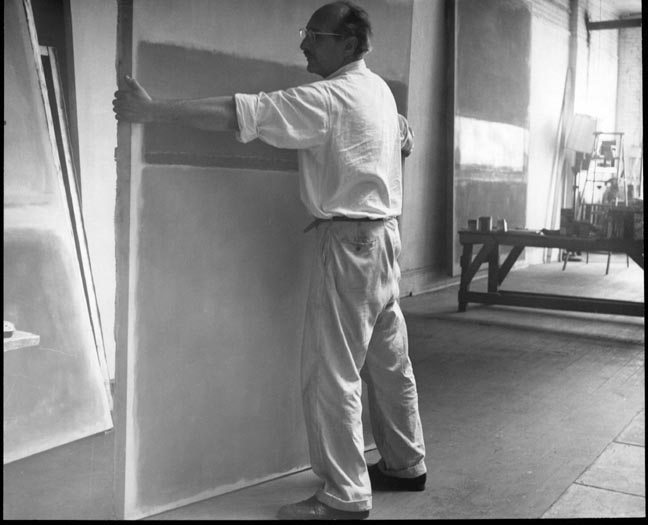
Rothko holding untitled (1954) ''I realize that historically the function of painting large pictures is something very grandiose and pompous. . . .The reason I paint them however. . . is precisely because I want to be intimate and human.'' Mark Rothko 1951 To say that Mark Rothko haunts Portland's collective civic psyche is perhaps an overstatement but there is a lot of evidence to the contrary (especially if one is sensitive to such things). This is partly because Portland as a city has bucked the predominant wisdom of the second half of the 20th century (we are pro approachable scale, anti corporate greed), just as its most famous son was. Portland is a city of shopkeepers rather than corporations as well as parks and public transportation, three things Rothko was also quite fond of. Rothko worked for his uncle, a shopkeeper and he painted subways, bridges and aggregate streets full of the masses. In short he was interested in the machine of civilization but sought a personal response amidst the modern impersonal grind. ... (more) Posted by Jeff Jahn on February 29, 2012 at 6:32 | Comments (0) PermalinkHistory on the Kaufman Rothkowitz on display at PAM 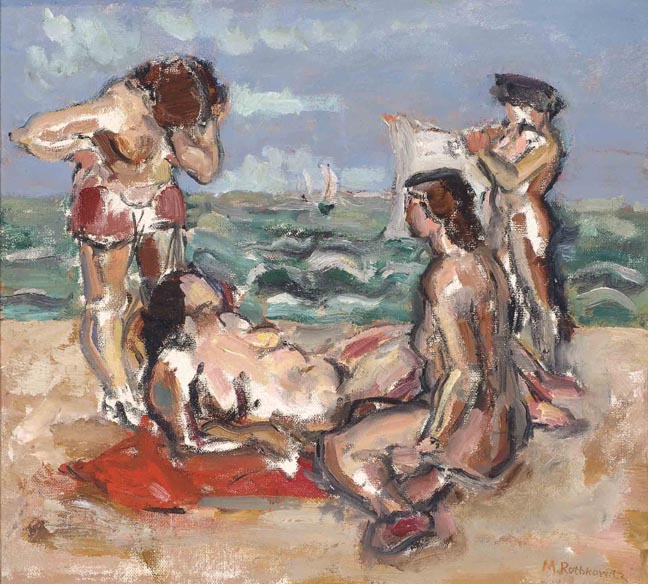 Mark Rothko Beach Scene, ca. 1928 Oil on canvas board 14.5 x 16 in. Reed College Art Collection Kaufman Memorial Collection Gift of Louis and Annette Kaufman Mark Rothko's family emigrated from Russia to Portland in 1913. Home life was intellectually rich and Rothko was fluent in Russian, Hebrew, Yiddish, and English by the time he attended Lincoln High School with Louis Kaufman, graduating with honors in three years. In 1921 Rothko was awarded a scholarship to Yale, but found Yale elitist and conservative. In response, Rothko and fellow student Aaron Director published the satirical review The Yale Saturday Evening Pest. Rothko withdrew from Yale his second year... (more) Posted by Guest on February 29, 2012 at 6:17 | Comments (0) PermalinkTuesday 12.27.11 Bringing Barr 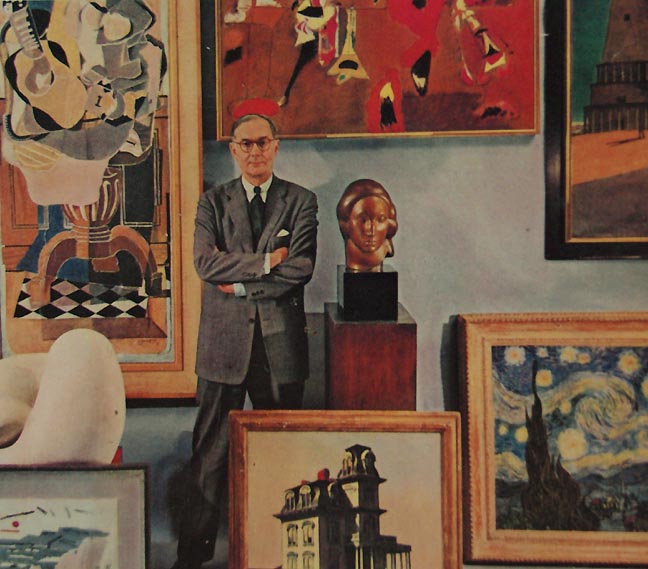 Alfred Barr Jr. It's been seventy-five years since Alfred H. Barr Jr.’s exhibition Cubism and Abstract Art. If you go to any museum that has modern art, his influence is visible in the organization and artists selected. Throughout the museum and curatorial world Barr’s shows and clout are controversial topics - and should be. Why should it be controversial? Anyone that has been that successful in creating a paradigm that still exists today has to be examined. It also happens that the paradigm that Barr created is the common understanding of modernism. On the one hand, it is not possible for everyone to have such clarity of thought on such new and difficult subjects, and on the other if there were a first rule of modernism, it would be to overturn the rules of your forefathers. So lets take a look at how Cubism and Abstract Art interacts with the notion of modernism and the period. Hindsight makes the past clear. There is one caveat about modernism that is often overlooked: every modernist statement was active within a time period where all these manifestos, artists’ statements and methods of science and industry were emphatic, pointed, aggressive, unquestionable, didactic - something to... (more) Posted by Alex Rauch on December 27, 2011 at 14:44 | Comments (0) PermalinkTuesday 11.29.11 Alfredo Jaar and Carsten Holler 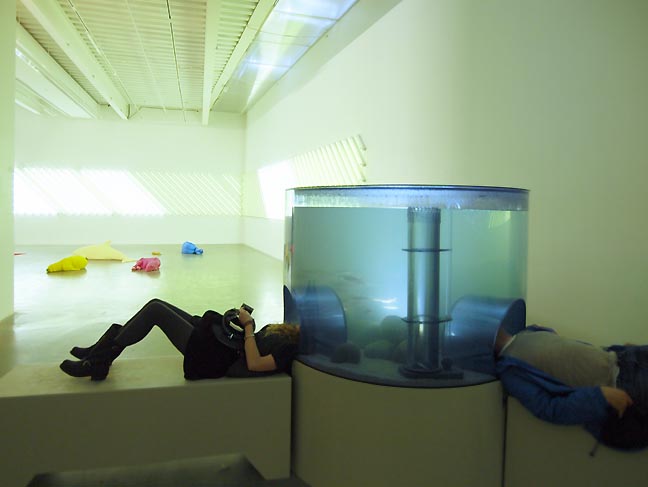 Carsten Holler's Double Light Corner (2011), Animal Group (2011) and Aquarium (1996) at the New Museum (photo Jeff Jahn) It isn't often that I write about programmatic archetypal curatorial strategies used in art exhibitions but two recent experiences; visiting Carsten Holler's Experience retrospective at the New Museum and Alfredo Jaar's talk "It is Difficult" sponsored by OCAC raise questions about the role of the artist and institution as well as how they ultimately interface with their viewers. 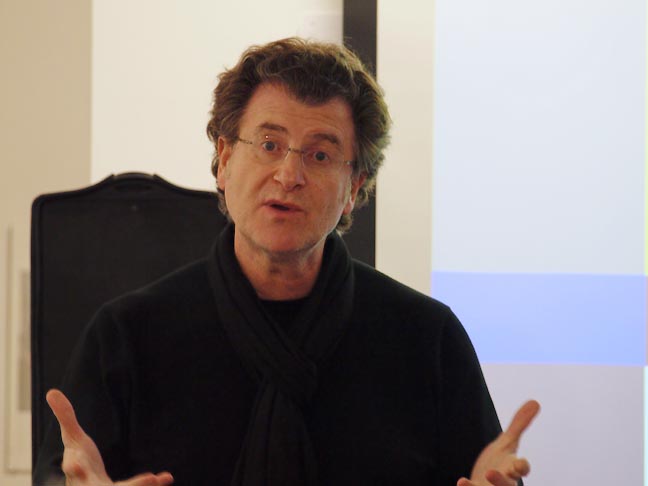
Alfredo Jaar speaking in Portland October 14th (photo Jeff Jahn) Though Holler and Jaar couldn't be more different, both highlight the way the art experience is attenuated by how the artist/institution divide is negotiated (Jaar is very selective and insists on carte blanche). True, all art exhibitions represent a kind of experience but some are intended primarily as such... (more) Posted by Jeff Jahn on November 29, 2011 at 14:47 | Comments (0) PermalinkWednesday 09.07.11 In preparation for Jesse Sugarmann's "Lido (The Pride Is Back)" at TBA 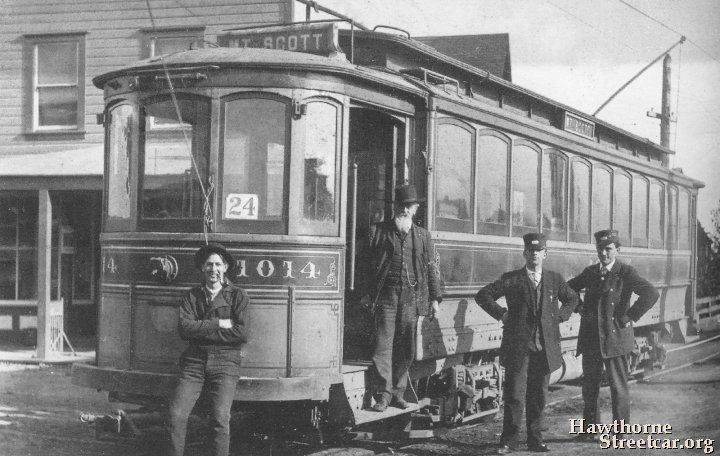 The original Hawthorne Streetcar There was a time when trolley cars and electric trains ruled the cityscape. Then, with the help of Standard Oil, Firestone Tire and other companies, General Motors went on a buying spree to purchase many of those transit systems and replace them with their own buses. To compete with Ford's Model T, GM bought up a lot of other car manufacturers (including making an early bid for Ford) in order to offer a variety of models and colors. So, when given the choice between riding in something crowded and stinky or something roomy, shiny and speedy, what followed (if not in as a direct line as this brief synopsis indicates) was our fascination with all things cars. Granted, GM didn't manage this feat of cultural obsession single-handedly. Cars were more freeing, and, one might argue... (more) Posted by Patrick Collier on September 07, 2011 at 22:17 | Comments (0) PermalinkThursday 07.21.11 Surveying Northwest Regional Surveys Part II 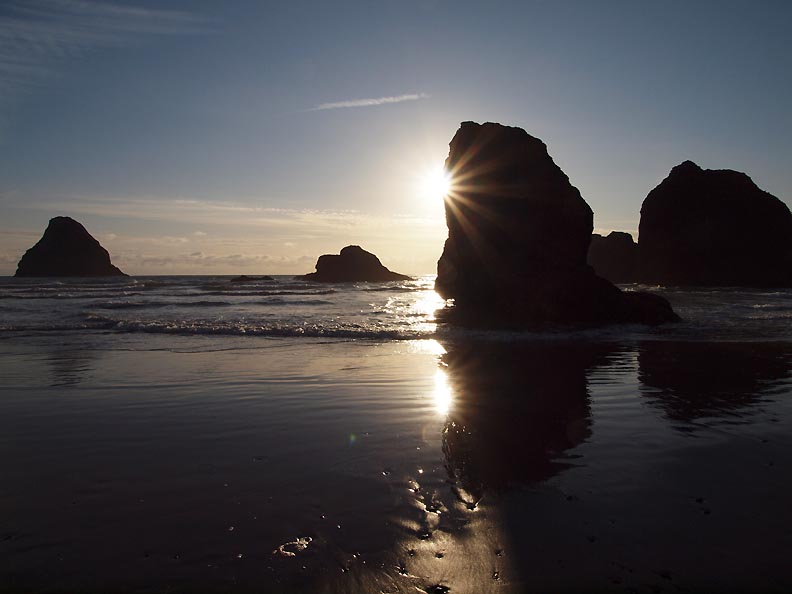
Whenever several institutional curators get together to talk about regional art and curating it, the discussion nearly always turns out the same (a discussion of familiar institutional minutiae and curatorial preferences)... so I avoid them. Well, except when I sit on them like I did in 2008 on OPB or 2003 for Core Sample with Michael Darling (then still at MoCA), Elizabeth Brown (The Henry), Randy Gragg (then at the Oregonian), Jane Beebe (PDX Contemporary) and myself. The point I made for this panel (by getting up from the genial table and walking with the mic) was that Portland was in a state of change and upheaval and any show that didn't address that energy wasn't relevant. It wasn't a brilliant statement simply a true one that in hindsight has been validated on an international level... (much more) Posted by Jeff Jahn on July 21, 2011 at 13:13 | Comments (0) PermalinkForest for the Tree Farm (Part I) 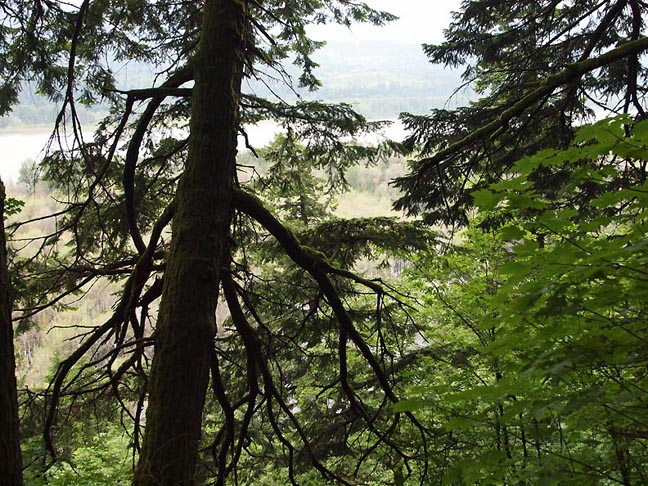
PAM hosted a panel discussion July 17th with the title "Northwest Awards & Biennials." The short blurb on PAM's website read: Bonnie Laing-Malcolmson moderates a lively discussion about Northwest art and how best to recognize the art and artists of the region. This followed a series of Tweets I had a couple weeks prior with @pamcollections about this topic... (more) Posted by Patrick Collier on July 21, 2011 at 12:32 | Comments (1) PermalinkFriday 07.15.11 A Segal at the Met's revival 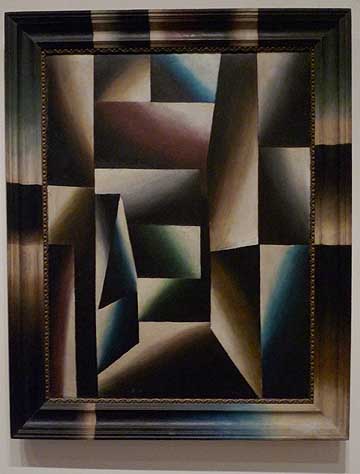 Arthur Segal's wonderful and still fresh Strasse auf Helgoland II (1924) at the Met. I noted the painting 2 years ago but Arthur Segal's Strasse auf Helgoland II is enjoying a bit of a revival with a shout out from Roberta Smith. In sychonicity, others like Minus Space's Matthew Deleget have just conducted some private and social media conversations about this gem from 1924 as well. I was thinking about it last week myself as one of my favorite things in The Metropolitan Museum. Besides the obvious (that we all have impeccable taste) why the revival? For me it is partly it's context within... (more) Posted by Jeff Jahn on July 15, 2011 at 13:48 | Comments (0) PermalinkFriday 04.22.11 Plethora Lucida 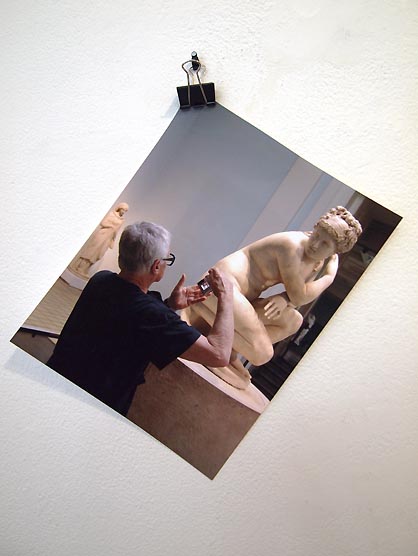 Jim Neidhardt at Blackfish (install photo Jeff Jahn) Next month is National Photography Month, but Portland, over-lapping like a temporal Rule of Thirds into May, has jumped the gun with “Photolucida.” A large number of area galleries are participating, and it is safe to say that there is a little something for every taste; and given the growing popularity of photography, there should be a bump in attendance, and perhaps in sales. However... (more) Posted by Patrick Collier on April 22, 2011 at 10:36 | Comments (1) PermalinkWednesday 12.29.10 Final Thoughts on 2010: First Impressions 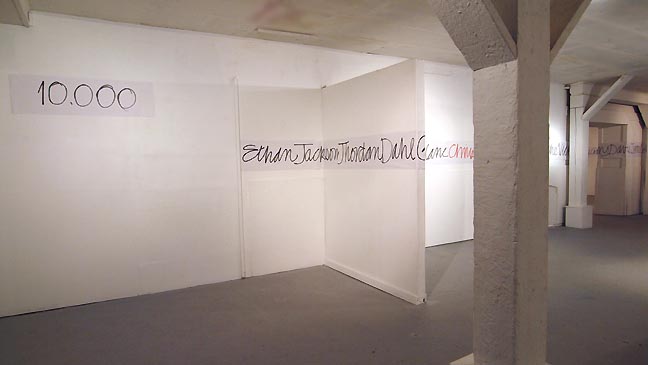 10,000 artists at Worksound by Jim Neidhardt For December’s First Friday, I dropped in at Worksound to see Jim Neidhardt’s installation, 10,000 Artists. The gallery had just opened for the evening, and only the gallery director, Modou Dieng, Neidhardt and a couple of the artist’s friends were in attendance. The installation consists of a paper banner stapled along all of the walls in the gallery. The paper is inscribed with the names... Posted by Patrick Collier on December 29, 2010 at 11:50 | Comments (9) PermalinkSaturday 09.04.10 R. Crumb and the larger Portland comix community by Mariel DeLacy “When I hear old music, its one of the few times I have a kind of looove
for humanity. You hear the best part of the soul of the common people. You know
– It’s their way of expressing their connection to eternity or whatever
you want to call it...” -Robert Crumb from Terry Zwigoff’s documentary, Crumb.
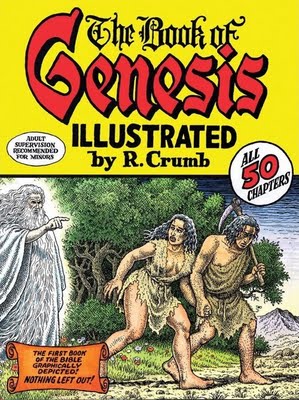 R. Crumb's The Book of Genesis at the Portland Art Museum and places that sell comic books Robert Crumb’s fans may have said the same thing about his cartoons in the 1960s and 1970s capturing the “spirit of the times.” Reverend Ivan Stang thrived off of Crumb’s common people soul expressed through his crude depictions of women, black people, or hippies that essentially evoked... (more) 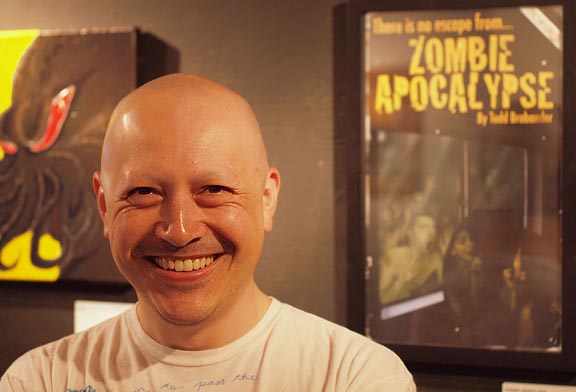
Kaebel Hashitani at Sequential Gallery (photo Jeff Jahn) Posted by Guest on September 04, 2010 at 13:53 | Comments (0) PermalinkSunday 08.01.10 Sol LeWitt Wall Drawing at PAM The wall drawings of Sol LeWitt, though dated by more than a decade, still resonate with the current artistic community. Sol LeWitt was a courageous artist with powerful insights as to both the workings and processes of art. He questioned drawing, painting, and sculpture unabashedly and directly with explorations of simple geometric form, color, and line. He also had the foresight to create work that would continue to spawn beyond his own lifespan, leaving us with gifts like Wall Drawing #304 currently on view at the Portland Art Museum.
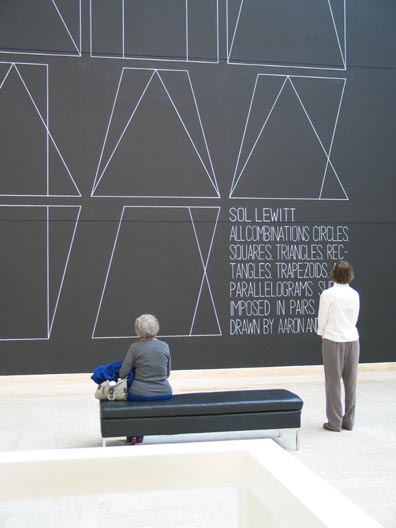 Sol LeWitt Wall Drawing #304 ...(more) Posted by Jascha Owens on August 01, 2010 at 15:40 | Comments (0) PermalinkMonday 06.28.10 Contemplating the furniture 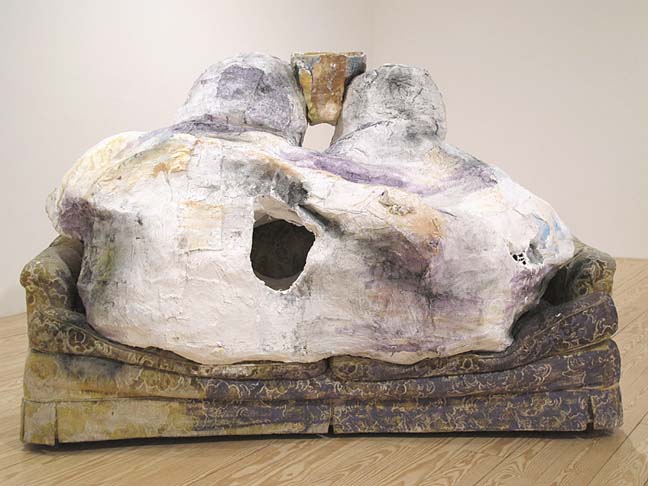
Jessica Jackson Hutchins' Love Seat Couple I've noticed a thread of furniture art in Portland over the last decade.. and while it's by no means unique (artists like Robert Rauschenbeg, Rachel Harrison, Donald Judd, Anne Hamilton, Roy Mc Makin, Damien Hirst, Carol Bove, Inigo Manglano Ovalle, Kiki Smith, Tom Sachs, Vito Acconci, Ed Keinholz, Jessica Stockholder etc. all use/design furniture) it bears taking a closer look... (more) Posted by Jeff Jahn on June 28, 2010 at 13:14 | Comments (0) PermalinkThursday 05.06.10 Donald Judd... now Exhibition essay: Donald Judd, White Box at The University of Oregon Portland by Jeff Jahn
Suddenly and without the prompt of a recent high profile major museum exhibition in the United States, the work of the preeminent artist Donald Judd (1928-1994) has enjoyed renewed interest amongst the most recent generations of artists. Reactions to his influence are everywhere in art, architecture and design schools today. So much so that if a clean box that avoids illusion or attention getting details by being well-made of metal, Plexiglas or douglas fir is present, so is Judd's legacy. The pity is that ubiquity extends a pervasively superficial understanding of Judd. 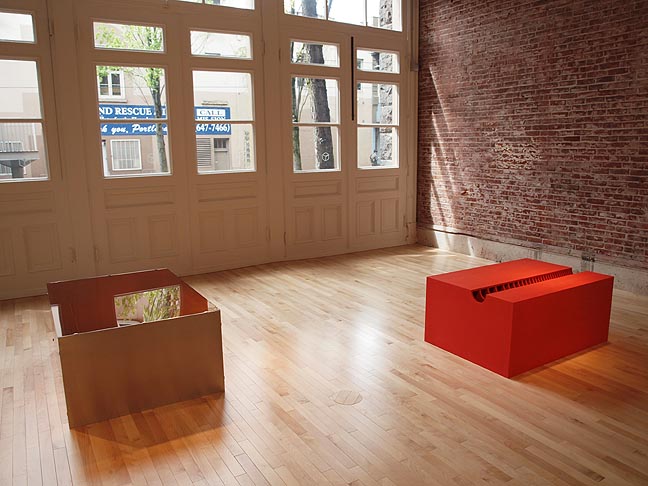
Judd Art (c) Judd Foundation. Licensed by VAGA, NYC (photo: Jeff Jahn) In the support of the conference Donald Judd Delegated Fabrication this exhibition is the first ever to look at Judd's process by paring major works with drawings by Judd for fabricators, production drawings by fabricators and other ephemera.... (more) Posted by Jeff Jahn on May 06, 2010 at 13:12 | Comments (0) PermalinkFriday 03.19.10 Is the Columbia River Crossing Doomed? In 2008 I was the first critic to call
for a design competition for the Columbia River Crossing and publicly argued
that the project had gone astray by becoming a blind man's elephant of conflicting
interests without a sufficiently talented architect capable of creating a compellingly cohesive
design... which they could then sell back to the public. Today the project is that
same quagmire involving the same design by committee engineers and an architecture
firm that merely makes cheap, mostly cheesy aesthetic gestures.
There hasnt been much critique in the generalist publications because the Oregonian does not have a proper staff architecture critic and they have utterly dropped the ball with horrible taglines like, "Can we afford Pretty?" when in fact the issue is more properly framed as a leaderless project in need of a head... ie a great architect. Sadly, the O has made themselves inconsequential to this very important discussion. Anyone with any real experience knows that the project wont get built without a serious design because this current franken-design doesn't make an arguement for itself. Previously I've described the design as similar to The Homer. What's more, Zaha Hadid has shown how the design could look and function great without extra tall design elements and Mayor Sam Adams noticed. 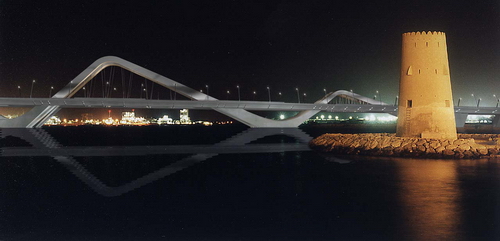
Zaha Hadid's Shiekh Zayed Bridge, excellent without tall structural elements Simply put the current design team is out of their league because they are simply responding to pressures rather than the world class solutions this project demands (a rethink is crucial right now but it will take world class minds). Meanwhile Governors Ted Kulongoski and Christine Gregoire have simply ignored the crucial question of a design that people will get behind. The project's complexity requires a great architect to come up a with a convincing design that creates a consensus... that takes innovation and that is something which usually comes from top talent. A world class architect would then become the salesman, something none of the politicians have the clout or political will to do. Why have all of the designs originated from Vancouver Washington with additions from Tallahassee Florida? Also, the new bridge IS needed, an 8.8 earthquake like the one Chile just experienced... (more) Posted by Jeff Jahn on March 19, 2010 at 12:20 | Comments (0) PermalinkFriday 02.26.10 Terry Winters at Reed College 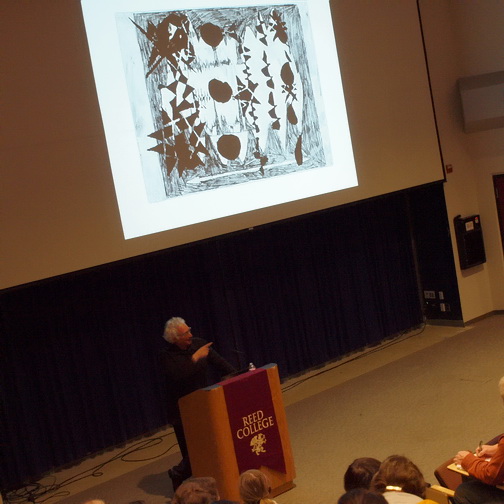 Terry Winters speaking at Reed College When you walk into the excellent exhibition of recent prints by Terry Winters at Reed College's Cooley Gallery, you are confronted by a remarkably consistent body of work that is the product of both a sustained rigor and an unflinching critical thought. Winters's work is a complex, evolving fusion of material and image while refusing to allow itself to be only defined as one or the other. His recent work often includes a series of self-generating forms that he describes as knots. The knots often intertwine with one another so that positive and negative space merge to create new kinds of forms with are in turn explored and expanded with additional layers of information. These forms serve as a guide to the pictorial and critical transformations that guide the intent behind most of the prints in the exhibition... (more) Posted by Arcy Douglass on February 26, 2010 at 9:00 | Comments (15) PermalinkTuesday 10.27.09 Taking Full Stock of the Portland art scene, Part I "The goal of our intellectual efforts cannot be a static, polished possession...In our many efforts toward knowledge, science, math, logic as in life itself, it is the process, not the terminus, that should concern us - if we are wise." Bruce Aune Rationalism, Empiricism, and Pragmatism The fall season is in full swing, I've been here a little over a decade now and PORT is heading towards its 5th anniversary, so it seems like an opportune time to take full stock of the development of the Portland art scene. Part I is general and interrelated (nine ways to improve, Portland as a model city, and our recent past). Part II will be more specific, discussing artists - young, mid-career and old - different types of institutions, etc. 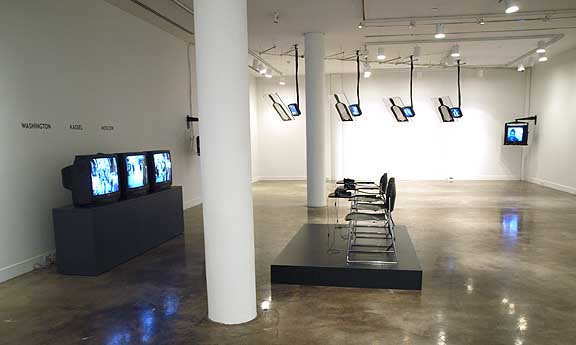 Broadcast at Lewis and Clark College (Dara Birnbaum's Hostage, 1994, in background) 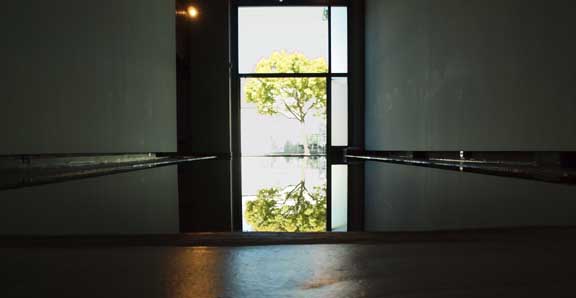 Rose McCormick's Grande Ronde concluded NAAU's Couture series last weekend There have been many excellent shows this season so far, including Rose McCormick's Grand Ronde, Broadcast at Lewis & Clark, Tom Cramer at Laura Russo, Jesse Hayward & Ethan Rose at TBA, Jordan Tull at Littlefield, Vanessa Renwick at Blue Sky, Ryan Pierce at Elizabeth Leach, and Processions at PSU, plus China Design Now and Raphael's Valeta at the Portland Art Museum. Portland definitely has a strong scene by anyone's standards, but it's not without its challenges. Only recently have our two top visual arts institutions (PAM and PNCA) embarked on serious campaigns with major donor education components. With PNCA celebrating its centennial this month, it's important to remember that they were the same entity a mere decade and a half ago and that only recently have the two organizations concentrated heavily on endowments and legacy gifts. The situation reminds me of the odd and sometimes beautiful combination of youth and age I come across in Portland. Now we seem to be at a tipping point where Portland could be more than just a great place for artists and become a better place for art. It's a subtle distinction that everyone should be considering..... (much more) Posted by Jeff Jahn on October 27, 2009 at 14:13 | Comments (2) PermalinkWednesday 06.17.09 Rothko's Portland 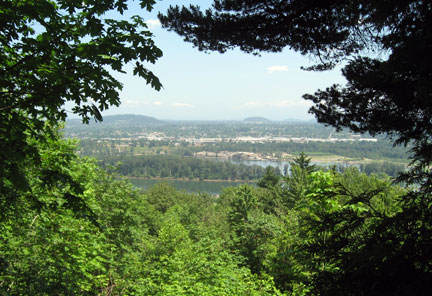 The view from SW Terwilliger Boulevard looking east toward Mt. Hood in the neighborhood in which Rothko spent most of his time in Portland. "(I spent my) youth in front of the endless space of the landscape of Oregon lying covered by wintery snows, in front of the monumental emptiness that is nothingness and at the same time part of it 'all.'" -Mark Rothko Marcus Rothkowitz arrived in Portland, Oregon in early September 1913 with his sister Sonia and his mother Kate. They had been in the United States for less than a month, having arrived in Brooklyn, New York on August 17, 1913 from Libau, Russia's main emigration port. Marcus, who would later change his name to Mark Rothko, was just a few weeks shy of his eleventh birthday. He was born on September 25, 1903 in Dvinsk and was, with his mother and sister, looking forward to starting a new life with his father, Jacob, and his two older brothers, Albert and Morris in Portland. The family had not been together in nearly three years. Portland marked the end of a long journey. It was a place that this family, like most immigrants, believed that their hard work would pay off and they could start anew. The Rothkowitzes were not alone in Portland. Jacob's brother, Samuel Weinstein, was already here and owned a successful wholesale clothing business called N & S Weinstein. The Weinsteins were important to the Rothkowitzes on both the West and East coasts. When Kate, Sonia and Mark arrived in Brooklyn, their first stop was to visit the Weinsteins in New Haven, Connecticut. It must have been a way for them to recharge their batteries after the long boat trip across the Atlantic and enjoy the comfort of family in an otherwise unfamiliar land. More... 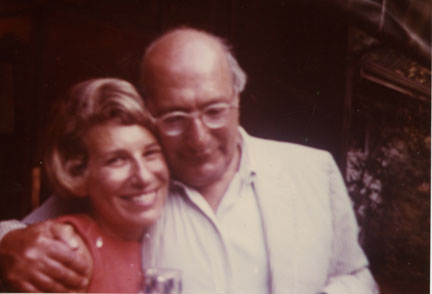 One of the my all time favorite photos of Rothko. If you wanted to know what Portland meant to Rothko, this is it. The photo was taken in 1968 and he his hugging Dorothy Reiter, Morris' daugther and his niece. They both look radiant, happy and absolutely content. The photo is very different than any comparable photo of Rothko taken in New York during the late 1960's. Portland remained a source for him until the end of his life. Image courtesy of the Oregon Jewish Museum. Posted by Arcy Douglass on June 17, 2009 at 9:13 | Comments (3) PermalinkTuesday 06.16.09 John Wesley's Battle of Przemysl at PAM 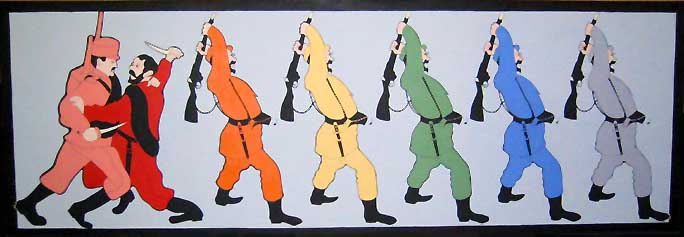 John Wesley's Battle of Przemysl, 1969, 34 x 96 inches One of my favorite works in the Portland Art Museum's permanent collection is John Wesley's simultaneously hilarious and wickedly dark painting, Battle of Przemysl. It's a sphynx like painting that may or may not be making a strange comment on; military expectations, conformity, homoeroticism, politics, the weird ideals of war, wartime music and historical head scratching all in one neat package with a thick black border. That border is not unlike...(more) Posted by Jeff Jahn on June 16, 2009 at 9:12 | Comments (0) PermalinkThursday 04.23.09 On Museums and Users Last night I attended one of the meetings about the integration of the Museum of Contemporary Craft and Pacific Northwest College Craft (PNCA). It was an interesting discussion because it was an honest look at how museums and university galleries address the changing needs of their respective audiences. It is revealing that most museums and galleries now find themselves asking fundamental questions about their existence such as asking what do people want out of the experience of going to a museum? Or what is the best way for museums to leverage their expertise in a changing and dynamic society? In other words, how does a museum stay relevant?
Posted by Arcy Douglass on April 23, 2009 at 14:00 | Comments (2) PermalinkTuesday 03.17.09 The Black Square 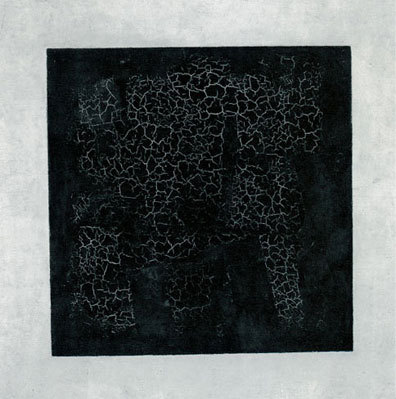 Kasimir Malevich, Black Square, 1913 [1914-15] The painted area of the Black Square is reinforced by the square canvas itself. The painted internal space of the square is removed and,at the same time,the painting takes on a three dimensional form by assuming the physical propeties of the canvas that exists in the space of the room. The result is that painting exists not as a window to somewhere else but as physical, tangible presence of the space of the viewer. Malevich created a new type of pictorial space that spoke as much to the space outside the boundaries of the painting as the space contained within it. "A non-objective art, phenomenal art is about seeing-about seeing, "feeling," and determining its aesthetically. Yet it seems every time we get a glimpse of this power of our seeing, we quickly give it away by attributing to it someone or something outside ourselves. We act as if we've seen a mirage or had a visitation; we make a mystique or a religion of it, instead of accepting the responsibility for what it is-that we perceive. It doesn't just happen to us- we make it happen, we participate directly in the forming of that envelope of the world and our being in it, and we do so at every moment of our lives. There is nothing more real, more interesting, more powerful, more informative, more important, or more beautiful" -Robert Irwin, Being and Circumstance: Notes Toward a Conditional Art , 1985 After I wrote in Art and Nature, I realized that there was something else there that placed the idea of process into context. It is the link that connects the artist to the viewer's experience and I think it is intention. What does intention mean? How could that change your experience of art? When Malevich paints a square, it is deliberate. It is something that he knows we are all familiar with. He is using a shape that we are all familiar with to establish a direct connection to the viewer beyond the edges of the painting. It is the vehicle and not the subject. It might not be clear at first glance, but Irwin was right, the subject is the viewer. This is why Maelvich changed what was considered to the potential of painting. The painting exists as much in the space of the room as it does in the boundary of the canvas. Malevich's intention to make art was to establish a direct connection to the viewer's experience of their own awareness. The viewer is the subject of the Black Square. 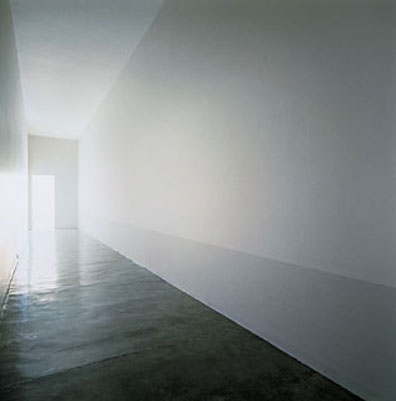 Robert Irwin, Varese Scrim, 1973 One of Irwin's early scrim pieces and was installed in a dedicated room in Panza's villa in Varese. Like many of the works that we have been discussing, the experience of the work is not the experience of the srim, it is the relationship between the scrim and the space. They work together and are inseparable. Like the zips in Newman's paintings, the scrim defines the room and the room defines the scrim. The scrim is the material but the art is the experience of the entire space. Posted by Arcy Douglass on March 17, 2009 at 7:21 | Comments (0) PermalinkThe Black Square-Conclusion 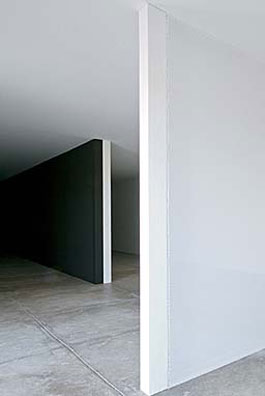 Robert Irwin, Installation at the Chinati Foundation, 2006-7 The scrims are freestanding in the spaces of the barracks. The frames are exposed so you are more aware of their edges. Some are painted white while others are black. Both challenge and redefine your perception of walking down the rooms. The works can't exist independently of the rooms in which they are placed. More... Posted by Arcy Douglass on March 17, 2009 at 7:20 | Comments (0) PermalinkTuesday 01.13.09 Art and Nature (Or an exploration of the emptiness of form and natural ordering systems)
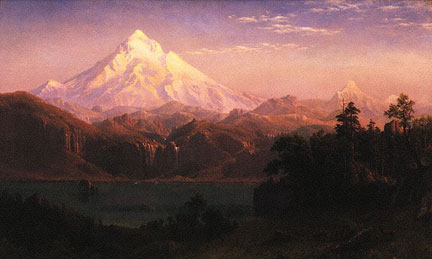 Albert Bierstadt, Mount Hood, Oregon 1869, Portland Art Museum. Every time I see this painting I am a little bit surprised, it always reveals a little something more about what it is like to live in the Pacific Northwest. I think that it was painted on the Washington side of the Columbia River Gorge looking south to Mt. Hood. Like most Bierstadt paintings, he s interested creating a representation of the mountain that might convey a larger truth about the land, or at least as he saw it. "It is quite commonly thought that the intellect is responsible for everything that is made and done. The intellect is a hazard in artwork. I mean, there are so many paintings that have gone down the drain because somebody got an idea in the middle." Agnes Martin in "Thin Gray Line" Vanity Fair, March 1989, p.56 Artists have always tried to find ways of translating and transforming nature in their work. In the Lascaux caves 25,000 years ago, it was the animals that they saw during their hunts. For the Greeks it was the beauty of the human body although I think that they were interested in the ideal of beauty rather than particular shapes of a single, living human being. Still, it was form of beauty and perfection that was based on the expression of natural forms. For painters like Leonardo Da Vinci nature was a system to be studied to make their paintings more true to our experience of daily life. He studied botany, anatomy and hydrodynamics to make his paintings more realistic and accurate of the creative forces of nature. For the best Chinese painters over the last thousand years, the natural world could be re-created in paintings and became a unique refuge where a person could get in touch with the forces of nature and find peace from busy lives. The paintings were never representational of a specific place but were literally formed by the creative forces of nature. A visit to a waterfall or a tall mountain was the direct experience of the contrasting forces of yin and yang by understanding all of the ways that they manifest themselves in nature. For the Chinese, the direct experience of nature, rather than its representation, was proof that we were a part of nature and that we had our own place in the universe. 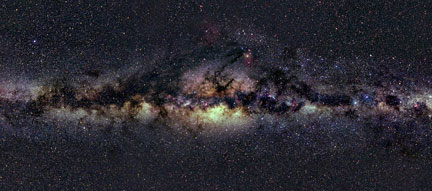 Hubble Space Telescope,Milky Way Galaxy,2002. This essay has attempted to reframe the terms in which it is possible for an artist to address their relationship to nature. Artists do no have to be satisfied with engaging nature in a superficial way and that it is possible to use some of the deeper systems that nature uses to organize itself to create an experience that might be called art. Posted by Arcy Douglass on January 13, 2009 at 19:45 | Comments (0) PermalinkMonday 11.24.08 Revisiting Michael Heizer's Double Negative 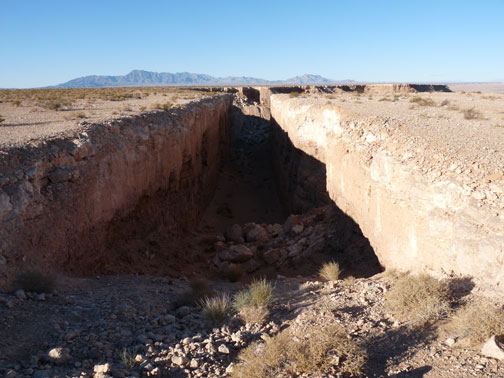 Double Negative in the late afternoon Like most things in life, it always takes you a little longer to find it than you had anticipated. I was driving across the top of Mormon Mesa, outside of Overton , Nevada, looking for Michael Heizer's Double Negative. Double Negative was conceived in 1969 and completed in 1970. Incredibly, Heizer was only 24 years old when it was completed. I had been to Double Negative a couple of times about ten years earlier. I lived in Las Vegas at the time and experiencing the work changed my life. I suppose in some way, I still I am trying to coming grips with what I had experienced during those trips. When Heizer went out to the edge of Mormon Mesa in 1970 his tools were a bulldozer, dynamite, probably a survey kit and a crew talented and brave enough to be able to make his conception a reality. He received funding for the lease of the land and support for the construction costs by the gallery owner Virginia Dwan. At the time the cost of the work was about $9,000. The work itself is two channels cut into opposite sides of the mesa. Each channel is approximately 9 meters deep and 10 meters wide. The western cut is about 230 meters long while the west cut is shorter, 100 meters long. Approximately, 244,800 tons of sand stone and rhyolite were relocated to make the work. The work is so large that there is not really an equivalent in the history of Western Art. It is longer than the Empire State Building is tall. When I was looking for the work and I was examining some of the valleys on the road to Double Negative, I was impressed with the fragility of the edge of the mesa. The edges are, after all, in a constant state of erosion. After the work had been marked, it must have taken an extremely brave person to make the first cut, maybe 6" or a 1' deep, and push it off the edge of the mesa. The drop off is extremely steep. There was no guarantee that the bulldozer would not just the follow the material off the edge of the mesa if the edge had given way and fallen down toward the river below. Everyone must have been holding there breaths because there would have been no way to know if the edge could support the weight of the bulldozer until they tried it. As work progressed it probably got a little easier and any large rocks that could not have been removed by the bulldozer would have been dynamited. After approximately, two weeks the excavations of the cuts were complete and the Heizer's initial conception of the work was complete. More... 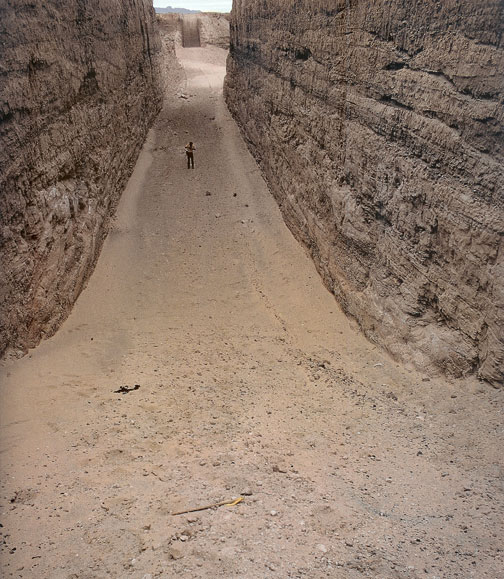 Double Negative soon after completion Posted by Arcy Douglass on November 24, 2008 at 10:45 | Comments (2) PermalinkWednesday 07.23.08 The Power of Place This post is a bit of an experiment but I have been thinking a lot about the way a photo can tell a story a about specific time and place. The photograph becomes an embodiement of an idea that is sometimes separate from the work itself. This essay is a study about the way that certain photos become more than just about the visual records of experience that exist in the worlds of art and architecture. At the same time, I would like to add that the photograph undermines any emphasis on any geographical location outside of the field of view of the camera. Images are one of the few things that available to everyone because all you need to have is a camera and access to the internet. The reason that I chose these images in the post is that they all convey a story. They seem to be closer to conveying an idea about a person or work rather simply documenting an experience. The ideas in these photographs seem to me to be essentially about place. A camera is extremely specific, it can only record what is in its field of view. If it is outside the field of view of the lens, it wouldn't be recorded. For me, that means that a camera is essentially about a specific place at a specific moment. The great thing is that that place can be anywhere now and availible to anyone. Everybody has the opportunity to participate. In a world that is becoming increasingly universal, there is still something compelling about the specific. The camera also separates the viewer from the event. The image can be used to convey a specific idea which might be different than the experience of the actual event. This post is probably closer to a slide lecture that happens to be on the internet rather than a normal post. There are plenty of artists with a few architects and architecture thrown in. It is worth noting that a piece of architecture is not easily relocated. Unless people make the effort to visit it, it will only exist for most people as an image. For me that is important lesson for artists. Within the confines of a camera you can create your own world that may or may not have anything to do with where you live on the planet. The camera is a great equalizer. As I was doing research for this post I was surprised that artists and architects have been using images this way since the very beginning. 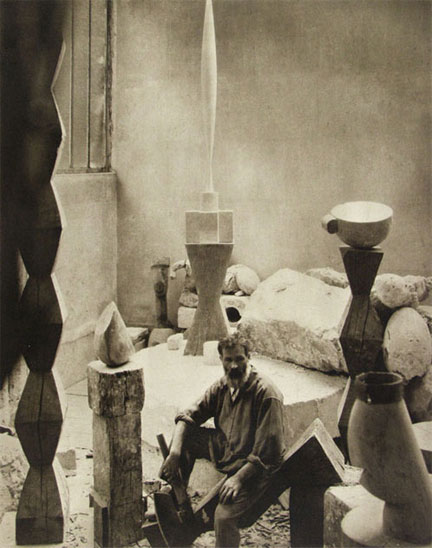 A self portrait of Brancusi in his studio. The idea behind the photo is the integration of a man and his work. In this photograph he is completely subordinate to his work, his figure barely fills up a third of the image. It is a photograph about the juxtaposition about his sculpture Bird in Space and himself. The rest of the studio comes into focus through our periperal vision and the long exposure also gives the studio an otherworldly light. He is literally one with his work. More... Posted by Arcy Douglass on July 23, 2008 at 12:10 | Comments (8) PermalinkFriday 07.18.08 Disjecta: Rematerializing? 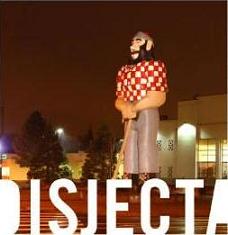 It's Disjecta, again... and again... and again. Long time Portlanders are probably pretty familiar with this promotional routine, and have already formed their opinions. For those of you who don't know the history, PORT takes a look back and a look forward after the jump. (More.) Posted by Megan Driscoll on July 18, 2008 at 8:45 | Comments (15) PermalinkThursday 06.26.08 A Better Bridge over the Columbia River
Zaha Hadid's Shiekh Zayed Bridge... it is time to up the ante on the new I-5 Columbia River crossing On Tuesday night it was announced that the Columbia River Crossing Taskforce has recommended that an entirely new bridge be built to replace the aging pair of bridges that constitute the only remaining lift spans on I-5. What hasn't been discussed much are the opportunities that the estimated 4.2 billion dollar project opens for a new type of bridge, one designed to meet 21st century ecological and humanistic pressures. By not putting an onus on smarter design the project has negatively polarized some that would otherwise welcome a better bridge. Yes the bridge is controversial but it's also the single best opportunity for Portland to put its money where it's mouth is, ethically, aesthetically, ecologically and technologically about being a progressive city. We aren't fond of cars here or more people, but they are unavoidable. Portlanders do however prefer better design, mass transit, human scale experiences, nature and green building ideas. The Tribune's article today emphasizes how the project must have MAX train mass transit. Ok that's a start, but it needs more...(more) Posted by Jeff Jahn on June 26, 2008 at 14:59 | Comments (8) PermalinkSunday 04.27.08 When Donald Judd Came to Portland "It isn't necessary for a work to have a lot of things to look at, to compare, to analyze one by one, to contemplate. The thing as a whole, its quality whole, is what is interesting. The main things are alone and are more intense, clear and powerful." -Donald Judd in his essay Specific Objects
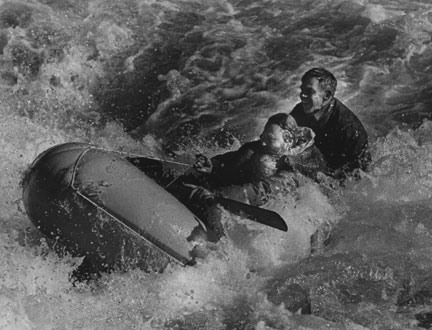 Donald Judd rafting down the Clackamas River with Bob Peirce Photograph taken by Bruce West at the Bottom of the Carter Bridge Rapids November 1974 The Portland Center for Visual Arts (PCVA) was based on a very simple premise: artists talking to artists. The PCVA was founded in 1971 by three artists Jay Backstrand, Mel Katz, and Michele Russo. The exhibition space was located on the third floor of 117 NW Fifth Ave. Katz wanted to give something to the community as well as bring to Portland some of the things that he missed from New York. Usually, the PCVA sent a letter to an artist explaining that they wanted to have a exhibition of the artist's work in the Northwest and could they follow up with a phone call the following week. This was a strategy that proved to be tremendously successful and they were soon able to attract some of the best artists in the country to come to Portland and have a show. The PVCA was unique in every sense of the word. The artists liked working with the PCVA because although there was a limited budget for each of the shows, there was never any limit to an artist's ideas. After the first few New York artists had a good experience working in Portland, the PCVA had an excellent reputation and the original artists often recommended other artists who might be willing to come out here. The founders set three objectives for the PCVA. First, they wanted to exhibit the best contemporary art that was being done in all regions of the United States. Second, they tried to stimulate commnuntiy awareness of the diversity and excellence of contemporary art through both exhibitions and others programs. Last, they wanted to bring the artist themselves to Portland to discuss their work. Over the 17 years they were able to put on an exhibition schedule that would have been successful and relevant even to MoMA. To give you some sense of the caliber of artists that have spent time in Portland because of the PCVA: Carl Andre, Yvonne Rainer, Lynda Benglis, Sol LeWitt, James Rosenquist, Daniel Buren, Ed Moses, Allan Kaprow, Frank Stella, Donald Judd, Alice Neel, John Baldesari, Chuck Close, Richard Serra, Chris Burden, Dan Flavin, Robert Irwin, James Turrell, Lucinda Childs, Andy Warhol and Agnes Martin just to name a few. It is hard to think of an arts institution that would have been more dynamic and relevant during that time period. The PCVA put on ten to fifteen visual arts exhibits every year as well as equal number of dance, music, and theater performances. There were a lot of things that were different about the PCVA and a comparable institution would not be created on the East or West Coast until the Dia Center was created in the late seventies. 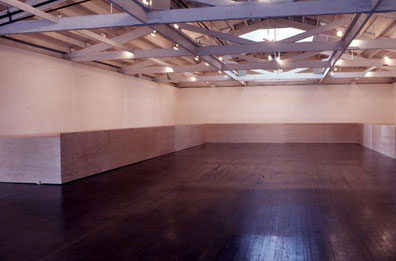 Donald Judd Untitled, 1974 (Detail) 3/4" Plywood on 2" x 4" subframe 65'-4" x 46'-3" x 40'-6" Installed at the Portland Center for Visual Arts in November 1974 (c) Donald Judd 2008 More... Posted by Arcy Douglass on April 27, 2008 at 22:57 | Comments (5) PermalinkMonday 02.18.08 On Form (or from Polykleitos to Janine Antoni) 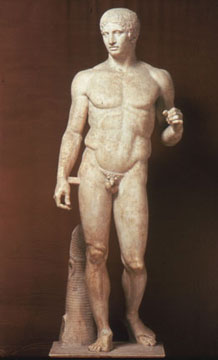 Polykleitos Doryphoros 450-440 B.C. When we look at art, are we only seduced by what we think is beautiful? Do we only respond to things that resonate with our sensibilities, our taste, or our history? As an artist is it our role to make beautiful things (paintings, sculptures, film, ideas etc...)? 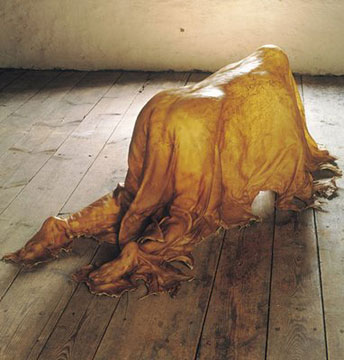 Janine Antoni Saddle 2000 Everyone has their own path, so everyone will have to choose for themselves but for me, I do not think that art has anything to do with the beautiful. In my own experience, my tastes are constantly evolving as I am interacting with the world and learning new things. How can I stand in judgment of what is beautiful and what is not? What I find ugly today, I might that I find that is urgently needed and beautiful tomorrow. More... Posted by Arcy Douglass on February 18, 2008 at 18:19 | Comments (6) PermalinkFriday 12.21.07 Barnett Newman and the Totem Poles of the Northwest Coast Indians "The Kwakiutl artist painting on a hide did not concern himself with the inconsequentials that made up the opulent social rivalries of the Northwest Coast Indian scene, nor did he, in the name of a higher purity, renounce the living world for the meaningless materialism of design. The abstract shape he used, his entire plastic language, was directed by a ritualistic will towards metaphysical understanding. The everyday realities he left to the toymakers; the pleasant play of non-objective pattern to the women basket weavers. To him a shape was a living thing, a vehicle for an abstract thought-complex, a carrier of the awesome feelings he felt before the terror of the unknowable." -Barnett Newman , The Ideographic Picture 1947 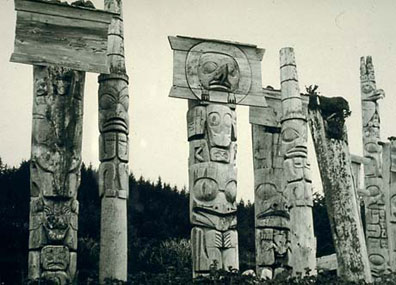 Haida Totems Queen Charlotte Island 1890's More... Posted by Arcy Douglass on December 21, 2007 at 9:30 | Comments (0) Permalink |
| s p o n s o r s |
 |
 |
 |
|
 |
|
 |
|
 |
|
 |
|
 |
|
 |
|
 |
|
 |
|
 |
|

|
Site Design: Jennifer Armbrust | • | Site Development: Philippe Blanc & Katherine Bovee | |