|

|
|||
|
Portland art blog + news + exhibition reviews + galleries + contemporary northwest art
|
||||




Radial imagery in Art Ok, I have a lot of theories about this trend/trope. There is a sense of inward and outward motion in this type of radial imagery. It might signify a way to both leave the world and or to project an outward sense of change? It is both explosive and inward reflective. Either way it is everywhere in art right now and there are plenty of historical precedents. I'll let the images speak for themselves:
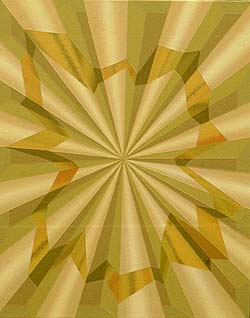 Tomma Abts, Teete, 2003, Carnegie Museum of Art, Pittsburgh. © Jon Pratty / 24 Hour Museum 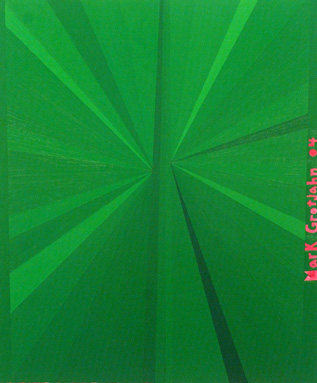 Mark Grotjahn Untitled (Green Butterfly Red Mark Grotjahn 04) 2004 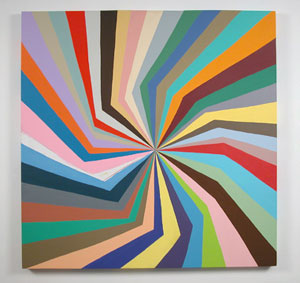 Chris Johanson Energyburst 2 (2002) 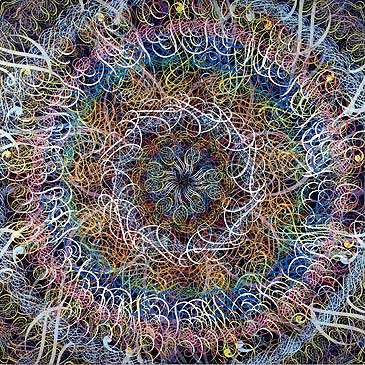 Ryan McGinness AN(N)US MIRABILIS (2006) 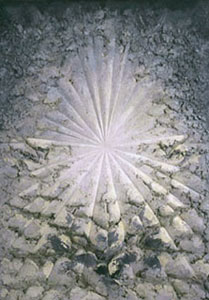 Jay DeFeo's The Rose 1958-1966 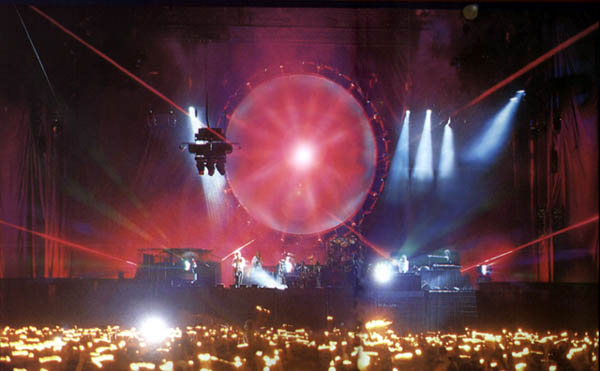 Pink Floyd in the Late 70's 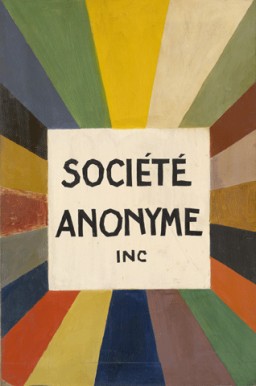 Artist unknown, Societe Anonyme Inc. Signboard, n.d. Paint on panel. Yale University Art Gallery Your thoughts? maybe it's that early 20th Century idea.. that the centre cannot hold? Posted by Jeff Jahn on September 10, 2007 at 0:30 | Comments (7) Comments There's an interesting radial painting in the SuperNatural exhibit by Joe Macca (if memory serves). Posted by: Megan Yeah its everywhere... Tom Cramer does it a lot and so does Ara Peterson. I think its a way for a square or rectangle tobe more than just a square or rectangle... its a kind of visual kinetic energy metaphor... I like to think it of it as AC current not DC. Robert Delaunay is another historical reference. -jeff Posted by: Double J I was impressed when I read about Mark Grotjahn exhibition at the Whitney. I like that one side of drawing is different from the other which has the surprising effect of flattening the image. It is surprising because as soon as you put a convergent point in the middle of the canvas you have, effectively, an infinite one point perspective. It is cool that he realized it and found a way to flatten the image and bring it back to the picture plane. He can have his space both ways. Chris Johansen's Energryburst 2 is cool is because he is mixing the geometry as passes through these shapes. The perimeter in marked out with these equal divisions that pass through the geometry of the circle before collapsing on to point. It is cool because when you are looking at the painting flattens out at the edges and then you hit the circle where everything bends and shifts before it collapses. It is like playing an acoustic song and then half through, stepping on the distortion pedal that creates an entirely new space. What about Bridget Riley? Posted by: Arcy Barbara Takenaga. Hilma af Klint. Posted by: lsd its ancient symbolism Posted by: Ray Solar Ryan Wilson Paulsen was telling me those concentric circle Joe Macca pieces are his "Asshole" series. I believe that was the correct title. Apparently, the colors used are randomly chosen from pictures of famous people (Condoleeza Rice, etc.). Joe Macca's work is always as charming as it is challenging. And I must admit I am always a sucker for radial imagery. I always thought of radial images as more claustrophobic, more implosive than explosive. All that powerful imagery contained within the crop of a canvas always seems so restricted, and seems to strip the imagery of any power it has. A very interesting contrast. Posted by: Calvin Ross Carl It is interesting that most of the examples of the paintings either with radiant lines or concentric circles have a very hard time sitting on the picture plane. Either your eye recedes toward the vanishing point or it shoots off the side of the canvas. The Ryan McGiness is a good example of the that. As soon as your eye settles on to one of the circles it sort of expands right off of the canvas. I think this why Ken Noland abandoned the concentric circles in the late sixties for paintings that incorporated some of the straight lines that resonate with the edge of the frame. That said, it is interesting to look at Ugo Rondine air brushed circles on a circular shaped canvas. In that case, the design resonates with the edges of the canvas. It will be interesting to see if Macca can generate some sort of stasis in his paintings by softening the edges of the circles. Does the softened edge of the circle make it sit in the picture plane? I guess we will find out at his show in January. Posted by: Arcy Post a comment Thanks for signing in, . Now you can comment. (sign out)
(If you haven't left a comment here before, you may need to be approved by
the site owner before your comment will appear. Until then, it won't appear
on the entry. Thanks for waiting.)
|
![[TypeKey Profile Page]](http://www.portlandart.net/nav-commenters.gif)
| s p o n s o r s |
 |
 |
 |
|
 |
|
 |
|
 |
|
 |
|
 |
|
 |
|
 |
|
 |
|

|
Site Design: Jennifer Armbrust | • | Site Development: Philippe Blanc & Katherine Bovee | |