|

|
|||
|
Portland art blog + news + exhibition reviews + galleries + contemporary northwest art
|
||||




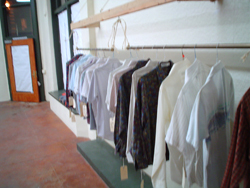
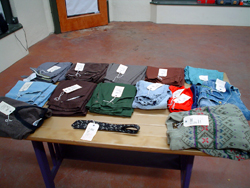
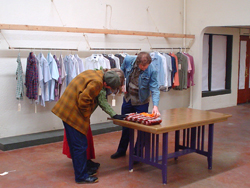
Artists using Clothes part 2 - Ghosttown The new Red 76 project, Ghosttown had its official consolidation last night, launching the Ghosttown clothing exchange.
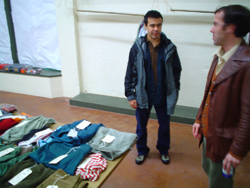
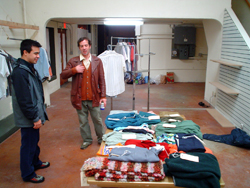
The space is located at 338 NW 6th Ave., Portland, OR Hours of Operation Wednesday- Sunday 12pm - 7pm This address is at the corner of Flanders and 6th in Northwest, an unremarkable retail space temporarily converted into a "store" by Red 76 masterminds Kris Soden and Sam Gould. The space infiltrates its surroundings. It is a quotidian brick storefront with large sheets of paper covering the windows. The way to find it is to look for the tiny drawing of a ghost on the glass door that opens directly onto the corner of the block. 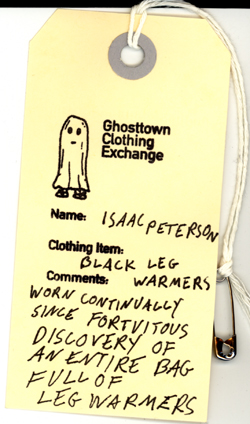
Upon entering Ghosttown, one discovers that it is indeed a store. Ghosttown operates on an alternative economy, based not on the government supported symbolism of money, but rather on the currency of interpersonal emotional interaction. Which to many, myself included, is distinctly more valuable. Ghosttown is a clothing store in which you make purchases with stories. Tags on the clothing tell the story of the item: "I never returned this after we broke up." Or "given to me by my best friend" or "A t-shirt purchased at a difficult time in my life." You bring in an article of your own clothing and write its story on the tag, then exchange it for a piece of clothing someone else has left. Wear the clothing around until it acquires another story, write that story on another tag and return the article to the exchange. Ghosttown articulates the invisible, the unremembered. The clothing becomes like a radioactive trace element introduced into the emotional/ ontological circulatory system of the city itself. Ghosttown theorizes an ontological economy, of which it is the nexus, the stock exchange. It operates in the gap between the individual and society, seeking to explore the distinctions between the two as well as the overlap. In America, we especially prize notions of individuality, and incorporate them trenchantly into every aspect of culture. It is perhaps ultimately, the singular American archetype, the culture icon we are most proud of. It becomes a cartoony cliche asserted over and over: James Dean, The Marlboro Man, Cowboys, Rockstars, The Bankrobber with the Heart of Gold, Rebels, Cops with their own brand of Justice, Tough Private Eyes, Tough anything, etc. etc. With this culture spending so much energy asserting the role of the individual, dialogues about interaction are sometimes incredibly poor. Why are American individualist archetypes always framed against the backdrop of society at large? The archetype perhaps only exists as a reactionary image. It is ultimately a social position after all. It is hard to deny that humans are in fact the most extensively socialized of any animal, far beyond even the termite. Perhaps this is what ultimately gave us the biological advantage (not the opposable thumb, don't monkeys have that too? Or the flamboyantly enlarged brain, or even divine mandate). However, the social implications of identity are often discarded in favor of the individualist archetype. But Ghosttown activates those invisible interactions, traces the circulatory system. It seeks to probe how deeply we effect one another, and how our interconnection defines us more elementally than our defiance ever could. I sometimes wonder: what if the entire human organism has been misunderstood? What if the actual organism is the city itself, and what we consider individuals are actually the cells of this larger creature? Our stories, relationships and emotional lives are its circulatory and nervous systems. Although this sounds like pure metaphor, think of the Portuguese Man of War, actually a colony of organisms that have become so symbiotic it is difficult to differentiate between a group of animals and a single jellyfish. In many ways, our symbiosis far outweighs our individualism. So there you have my ontological theory in its entirety. Maybe Portland is a single jellyfish. Ghosttown hasn't officially started yet, but the work engages these ideas. It will be interesting to see what Ghosttown's trace of the emotional/ ontological circulatory system of Portland reveals, and how detailed and extensive that trace will be. The work certainly serves as a rich forum for ontological debate, and you can participate without totally losing your rebel individuality. 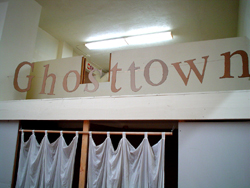
Posted by Isaac Peterson on December 30, 2005 at 15:24 | Comments (1) Comments Artists wearing clothes, painting clothing on people in paintings, making sculptures of clothed people, selling clothing at Redlight of Buffalo Exchange to buy art supplies, Charles Ray's "All My Clothes", Brodie Large's plexi-box containing all of his clothes, Adam Fuss photographing old dresses, Susan Seubert's ditto, Andrea Zittel making uniform clothing, It Can Change making T-Shirts that travel, Bill Will making an American Flag with red, white, and blue clothing, Howard Fried's "All My Dirty Blue Clothes", MK Guth's dresses made of bees, The Art Guys selling advertising space on their suits, Joseph Beuys' Felt Suit, the puffy shirt from Seinfeld, Michael Brophy's "City Coat", dresses made with credit cards, suits made of money, Michael Oman Reagan applying flourescent paint to the underside of his collar, Richard Prince's t-shirt paintings, Erwin Wurm, Eddie Murphy, and others "Fat Suits", Pink Floyd's man in a light bulb suit, Flea's stuffed animal pants, Suzy Root's little tall dresses... Am I forgetting anything? Posted by: jerseyjoe Post a comment Thanks for signing in, . Now you can comment. (sign out)
(If you haven't left a comment here before, you may need to be approved by
the site owner before your comment will appear. Until then, it won't appear
on the entry. Thanks for waiting.)
|
![[TypeKey Profile Page]](http://www.portlandart.net/nav-commenters.gif)
| s p o n s o r s |
 |
 |
 |
|
 |
|
 |
|
 |
|
 |
|
 |
|
 |
|
 |
|
 |
|

|
Site Design: Jennifer Armbrust | • | Site Development: Philippe Blanc & Katherine Bovee | |