|

|
|||
|
Portland art blog + news + exhibition reviews + galleries + contemporary northwest art
|
||||




Artists using Clothes part 1- Chandra Bocci Two significant works, one having just closed and the other just about to open, have involved artists using clothes as a sculptural material or as a vehicle for interaction. These are Chandra Bocci's Clothes Towers and Ghosttown.
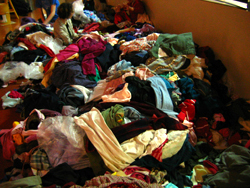
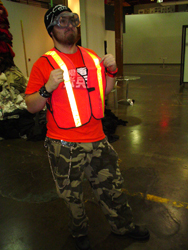
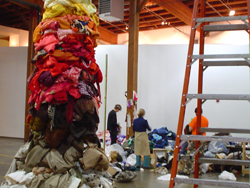
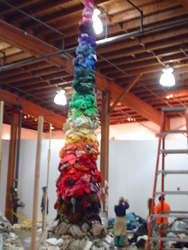
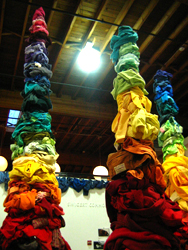
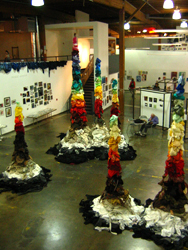
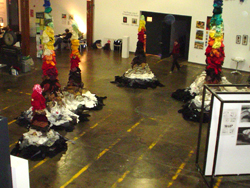
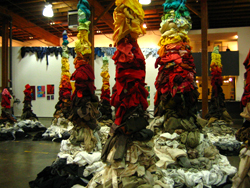
You may not have seen the Clothes Towers, because I wasn't quick witted enough to blog it while it was up, but having been around PNCA while it was being constructed I photographed the whole process. So now I can give you some idea of it through a retro-active photoblog, even though it has already been de-installed. Organized by student services and the student activities council at PNCA, it was designed by Chandra Bocci and cooperatively constructed by the student body at PNCA. 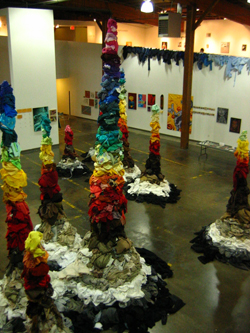
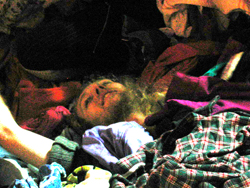
This installation is easy to locate within Bocci's general artistic phenomenology. Clothes are organized according to the spectrum and attached to freestanding wooden center structures. The towers are arranged in the space organically, giving the appearance of "just having grown there." The spectral organization reads as a familiar element from Bocci's work, the rainbow. The effect on the whole is of a "giant rainbow forest" or "giant rainbow stalagmites", and Bocci's very first drawings for the work were of drip castles, made by squeezing liquid sand through your fingers at the beach (you have to remember when you were a kid). Although this piece relies on vocabulary already firmly established in Bocci's artistic lexicon (spectral organization /the rainbow), what was incredible about this piece was its sheer magnitude. This piece hints at Bocci's future, showing what the installation artist is really capable of given the right resources and construction assistants. The installation commanded the formidable space of the Swigert commons, which had overpowered the wonderful Ernesto Neto piece earlier in the year. The tallest tower was more than 30 feet high and the whole installation used nearly one ton of clothing (generously provided for the show by William Temple House). Because all of the colors occurred at the same height on each tower, the entire space became organized into levels of the spectrum. The work implied the presence of huge planes of color, floating parallel to the ground, through which the viewer walked as they navigated the forest. As with other Bocci installations, the space was transformed to become whimsical, magical, fantastic, a materialization of an inebriated cartoon world. The change in the feel of the space was apparent in the behavior of the students and faculty during construction and after the piece was finished, who were constantly playing dress up, having clothes fights, playing hide and seek behind the towers, etc., etc. Although perhaps less conceptually complex than previous Bocci installations, it was nice to see the magnitude increase. It was a simple idea with an overwhelming physical presence. The sheer size and physical accomplishment of the piece hint at the future of this driven young installation artist. 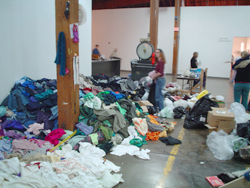
Posted by Isaac Peterson on December 30, 2005 at 15:03 | Comments (0) Comments Post a comment Thanks for signing in, . Now you can comment. (sign out)
(If you haven't left a comment here before, you may need to be approved by
the site owner before your comment will appear. Until then, it won't appear
on the entry. Thanks for waiting.)
|
| s p o n s o r s |
 |
 |
 |
|
 |
|
 |
|
 |
|
 |
|
 |
|
 |
|
 |
|
 |
|

|
Site Design: Jennifer Armbrust | • | Site Development: Philippe Blanc & Katherine Bovee | |