|

|
|||
|
Portland art blog + news + exhibition reviews + galleries + contemporary northwest art
|
||||




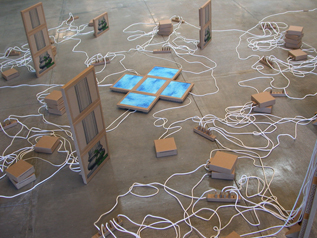
Utopia and Obsolescence Legacy: Boxed Version. PORT's own Katherine Bovee and husband Philippe Blanc explore ideas of utopia and virtual experience in Legacy: Boxed Version, an installation in PCC Sylvania's Northview Gallery.
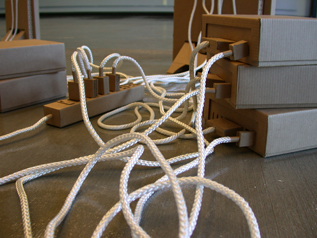
The sculptures are low material replicas of high culture objects: computers, monitors, and power cables facsimiled from cardboard and white clothesline. The pieces are crafted with meticulous precision, the model of choice, the Mac Mini, is instantly recognizable, and there appears to be no variation between individual replicas. There is a high level of detail in the replications, including cardboard switches on power strips and cardboard prongs on plugs. Clothesline cables attach the cardboard computers to towers of flatscreen cardboard monitors. The monitors "display" images of Grecian columns wreathed in vines. At the center of the piece five cardboard monitors flat on the ground form a reflecting pool. Legacy finds a curious intersection between the origins of Western culture in ancient Greece, the virtual space of video game environments, and utopian models.
Video games simulate virtual utopian environments and mental landscapes. Because these environments are the "ultimate" experience, they are extreme and easily codified. Most video games will cycle through a system of idealized environments in some way. There will be an underwater level of some sort, a fire level, a cloud level, an underground maze, etc. The origins of Western culture, and Western art are codified and simulated in the "ancient ruins" level of many video games, an environment of crumbling Grecian columns overgrown with plant life, resonating with lost knowledge. Legacy is a transposition of this mindscape into the real, where the role of the computer is misdirected and rechanneled. The supposed power of the computer is that it transports consciousness into virtual worlds, but as Baudrillard points out (in his 1986 essay, America) the relationship between the mind and the object is perhaps more important: "What people are contemplating on their word-processor screens is the operation of their own brains. What we are wanting here is to see our thoughts unfolding before us - and this itself is a superstition." Legacy strips high tech of its aura, and disperses the monitor's power as a portal. Instead, carrying our everyday knowledge of computers into the gallery, we are forced to view them as objects and architecture. They create a small-scale utopian theatre, one that reveals the limitations of utopian ideals. Perhaps true utopias only really exist in video games, and the industry's ethos of rapidly discarding the obsolete in favor of a more "perfect" model is just another unacknowledged superstition. -Isaac Peterson Posted by Isaac Peterson on July 29, 2005 at 19:16 | Comments (0) Comments Post a comment Thanks for signing in, . Now you can comment. (sign out)
(If you haven't left a comment here before, you may need to be approved by
the site owner before your comment will appear. Until then, it won't appear
on the entry. Thanks for waiting.)
|
| s p o n s o r s |
 |
 |
 |
|
 |
|
 |
|
 |
|
 |
|
 |
|
 |
|
 |
|
 |
|

|
Site Design: Jennifer Armbrust | • | Site Development: Philippe Blanc & Katherine Bovee | |