|

|
|||
|
Portland art blog + news + exhibition reviews + galleries + contemporary northwest art
|
||||




Van Gogh for PAM 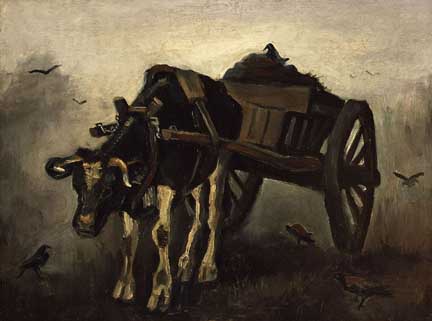
Allright, by now most everyone should know the Portland Art Museum has received a major gift of a Vincent van Gogh painting, The Ox-Cart (1884) from Roseburg's Fred and Frances Sohn. Frankly, such a generous gift is the only way such a painting by van Gogh could enter the museum's collection and it's worth many millions (in today's market 5-10 is my conservative guess, but that's rational thinking, at auction it maybe could have hit approached 15 or more). The Rijksmuseum has the other version of this work, which features a red ox instead of the black one here. Basically the money doesn't matter, it is the fact that its an important piece for the premier public collection in the state. 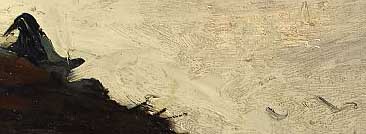 detail of van Gogh's The Ox-Cart (1884) So how good is it? It's an early work, one that lead up to his first major piece The Potato Eaters. The central subject itself is a little bit ungainly but the background is disturbing and magical. I particularly like the black bird in the cart and the work's relationship to Goya's The Sleep of Reason Produces Monsters. I see resemblance to the work of Northwest Mystics like Jay Steensma and Morris Graves who had similar interests, though at this point Van Gogh was deeply focused on depicting the realities of peasants. The background is what makes this painting and we see a young artist showing some signs of his greatest works like Crows Over Cornfields. For most museums this post impressionist work would be a dream come true and for PAM it holds out the promise that those who hold major works by Warhol, Basquiat, Martin, Johns, Motherwell, Judd and Gauguin etc. will eventually follow suit in a similar fashion in an effort to bulk up the collection. The Sohn's have done a great thing. Here is what the museum had to say about the work: Painted in Nuenen, The Netherlands, early in van Gogh's career, The Ox-Cart (1884) is part of his exploration of peasant life, which included dozens of studies of peasants, farm work, and the rural landscape. Van Gogh had returned to his father's home in Nuenen, after he had failed at the clergy and given away all of his possessions. He rented studio space from the local church and seriously pursued his career as an artist. Intrigued by the work of Rembrandt, the great Dutch genre traditions, and Millet, van Gogh's paintings from Nuenen show his deep identification with the simple, yet difficult life of peasants eking out a humble existence on the land. This exploration of the dank and dark landscape is a sharp contrast to his later work produced in southern France where he was inspired by the bright colors of the region and the work of fellow artists Emile Bernard and Paul Gauguin. As van Gogh observed about Nuenen in a letter to his brother Theo in Paris , "…out of doors everything is mournful. In fact the fields consist entirely of patches of black earth and snow; on some days one seems to see nothing but fog and mud; in the evening the red sun, in the morning crows." His work in Nuenen (1883 - 1885) established his mature vocabulary as a painter - the physicality of the paint and the essential formal vocabulary of his aesthetics. Van Gogh's visual expression of emotions through color and the physicality of the brushstrokes redefined art-making practices and have influenced generations of artists. The Ox-Cart represents a critical step in his artistic journey. It helped to set the stage for his seminal painting, The Potato Eaters (1885), and for his later work produced in Arles and Auvers-sur-Oise (1888-90). "In Nuenen, van Gogh found his sense of self. In Arles , van Gogh found his place in history," said chief curator Bruce Guenther, who facilitated the gift. Posted by Jeff Jahn on October 15, 2007 at 17:48 | Comments (0) Comments Post a comment Thanks for signing in, . Now you can comment. (sign out)
(If you haven't left a comment here before, you may need to be approved by
the site owner before your comment will appear. Until then, it won't appear
on the entry. Thanks for waiting.)
|
| s p o n s o r s |
 |
 |
 |
|
 |
|
 |
|
 |
|
 |
|
 |
|
 |
|
 |
|
 |
|

|
Site Design: Jennifer Armbrust | • | Site Development: Philippe Blanc & Katherine Bovee | |