|

|
|||
|
Portland art blog + news + exhibition reviews + galleries + contemporary northwest art
|
||||




An Afternoon with Mary Henry
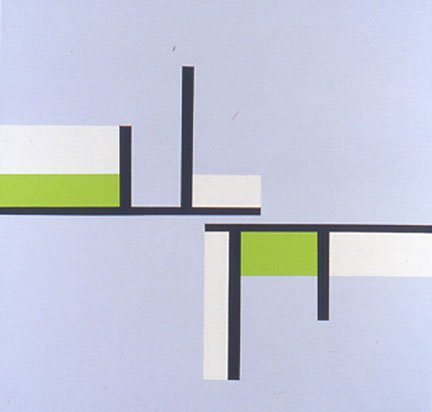
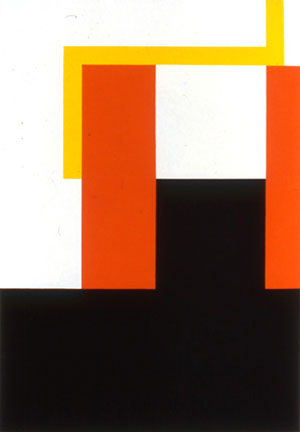
I knew that Mary Henry studied for a time with Lazlo Maholy Nagy who was a famous Hungarian artist who came to the United States after teaching at the Bauhaus in Germany. But there was something under the surface of these paintings that was constantly drawing me forward little by little, trying to learn more about who Mary Henry really is. It wasn't until I learned more about her life that I finally learned what the paintings were trying to teach me.
"I lived in Palo Alto when I left high school," Mary Henry said, recalling her life's journey with us one recent afternoon. "I had a friend - a Japanese girl. I admired her very much because I thought she was perfect. When I found out she had spent a year at California College of Arts and Crafts (CCAC). I thought, 'Wow, that's wonderful.' She said, 'Why don't you do it?' I didn't have any money. She said, 'Work for a year and save your money.' So I did. I worked and saved my money. I had enough money then to go for half a year to school. So I went for half a year and had to quit. After I had gone to school for half a year, I decided I loved it."
"The reason why I knew of him [Maholy Nagy] was that I heard him lecture. I could hardly understand a word he said, but I knew it was good. So I went to Chicago and then my mother and child came to join me. At one point during that time, he asked me to teach at the school. I said no because I had to go with my husband. He said that's alright. He was very nice. I liked him a lot. But he was very strong too. His lectures were vital. I spent a couple of years, but at the end of that time Maholy Nagy died." Set adrift once again, Mary Henry found refuge with her husband in Arkansas, but her heart was still set on being an artist. It had become a part of her and she could not give it up.
"When that was over, I went to the South where my husband was. That picture with the cabin and the flood underneath (Spring in Arkansas). That's the way it really was. I didn't do any art at that time except once in a while. But these years ... well, I just got by. After a while it was 1950. I said, 'This is enough. I don't want to stay anymore. I'm going to Palo Alto, if you want to come, you can, if not, this is it.' So I went to Palo Alto." She went back to where she was raised to start her life over once more, but now with the confidence that she could live as an artist. There was never any easy moment. There was always tension between being an artist, a wife and a mother with their sometimes contradictory demands. She found a job in San Francisco where she made designs for over fifty murals in five years. Some of them, like those for Hewlett Packard were executed in Tesera glass, more or less mosaic made of small glass tiles.
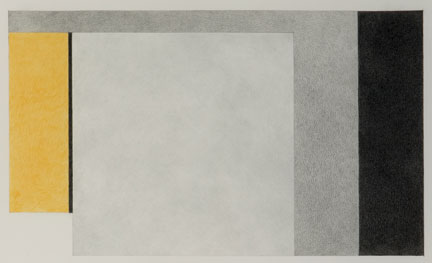
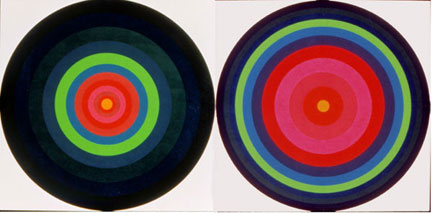
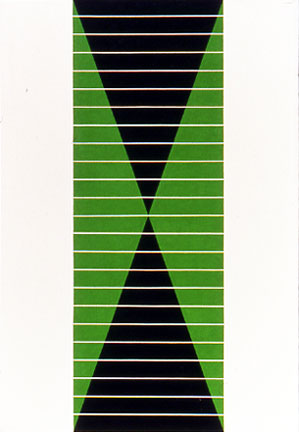
It was in Mendocino that Mary Henry found the refuge that she had been seeking all of those years. In a big house, she had room to paint and time to do pursue it. It was in the early '60s when Op Art was very popular, and she called her first series of paintings "On/ Off." "Anyway, I went to Mendocino and suddenly I felt free for the first time in my life. I felt I could do anything. So I started painting. I had canvas and paints, oil paints in those days. They were more abstract. In fact the were very geometric. I didn't know what to do with painting because I had never been by myself. I just fiddled around and did a few paintings in oil that disappeared. Someone said, 'Why don't you use acrylic?' I got a show out of it."
This is only the beginning of the story, but for me there is something of the struggle of her early years that comes through in the tranquility of her paintings. The last words of this article should be her own: "I just kept painting more and more. I never stopped. That's the story of my life. I didn't quit." Mary Henry is currently participating in the Elegantly Frugal, Deceptively Simple show at Southern Oregon University in Ashland, Oregon. Elegantly Frugal is a group show that includes work by Anne Appleby, Victoria Haven, Patsy Krebs, Peter Millet, Matt Sellars, Richard Wilson, Robert Yoder and Mary Henry. The show is up at SOU until December 8, 2007. Posted by Arcy Douglass on October 04, 2007 at 12:10 | Comments (0) Comments Post a comment Thanks for signing in, . Now you can comment. (sign out)
(If you haven't left a comment here before, you may need to be approved by
the site owner before your comment will appear. Until then, it won't appear
on the entry. Thanks for waiting.)
|
| s p o n s o r s |
 |
 |
 |
|
 |
|
 |
|
 |
|
 |
|
 |
|
 |
|
 |
|
 |
|

|
Site Design: Jennifer Armbrust | • | Site Development: Philippe Blanc & Katherine Bovee | |