|

|
|||
|
Portland art blog + news + exhibition reviews + galleries + contemporary northwest art
|
||||




Rick Steves, Chief Art Critic of the New York Times? 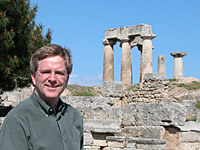
Tyler Green once again has the scoop... Kimmelman is leaving New York but not the New York Times. Kimmelman just spoke to a packed house in Portland both delighting the crowd with his charm and somewhat annoying myself and others with his light travelogue style (look to the comments). Looks like there will be more travelogues, not a bad thing but does the chief art critic of the NYT's have to be the art world's Rick Steves? Yes, in my mind Roberta Smith is already the chief art critic and Ive been annoyed with newspaper art criticism that isn't art criticism for some time. I read Kimmelman to revisit an excellent writer's craft but in terms of content I end up feeling like I just read the brochure not the review. I do think Kimmelman could do excellent television shows on art travel, just don't call it criticism. Posted by Jeff Jahn on March 06, 2007 at 11:33 | Comments (2) Comments The amount of flak getting thrown at Kimmelman’s book “The Accidental Masterpiece” makes me think the establishment art community protests too much. After reading the first three chapters, I agree that it lacks even a hint of traditional art criticism, but I also understand his intent is to avoid playing the roll of the critic. By his use of personal stories and intimate histories of artists and other unusual characters, Kimmelman offers a philosophical examination of Man’s relationship with art and the human esthetic experience. He seems to have created a group of stories and a narrative that takes on much of what Irwin Edman covered in his early 20th century introduction to aesthetics “Arts and the Man”. As the first paragraph from the synopsis on the dust jacket he wants to show us “that art provides us with clues about how to live our own lives more fully”. Kimmelman dwells on my favorite subject, the discussion of why art is relevant to all who are willing to look and think about what they see and experience. The reference to Immanuel Kant’s comment on crossing the Alps as “the terrifying sublime” is an obvious nod to the some important esthetic revelations from the Enlightenment. In his discussion of the life and death of Ray Johnson, Kimmelman folds the ultimate existential question posed by Camus and Sartre into the idea of a person’s life as a work of art and art as a mirror of life. The stories are vivid yet concise and he refrains from making conclusive judgments about his characters in favor of attempting to sharpen the reader’s personal skills of observation. By guiding the reader in this manor his intent is clearly to encourage a fresh approach toward self observation in order to see ones own life as a work of art. Simply put, it’s about the process and importance of determining the meaning of our lives. It’s about building a personal connection to the world and appreciating the context we have with the life we inhabit. The style of “art travelogue” Kimmelman uses seems to be a deliberate attempt to deliver all this heady intellectualism in a comfortable package that is simply a good read. He naturally wants the broadest possible audience. He could accomplish very few of his objectives if he simply stuck to traditional art criticism. Edman points out in the last chapter of his book that “Superficially, no two people would seem to be farther apart than the artist and the philosopher”. Where Edman uses a rigorous analytical method to bring the two together, Kimmelman use stories about people he loves and admires. You catch more flies with honey than vinegar. You get more readers with stories of human nature than you do with philosophical analysis or art criticism. The Accidental Masterpiece offers an engaging alterative view to those who are immersed in the world of art. The book offers an entertaining and accessible starting point to those who have yet to dip their toes in the ocean of art we live in. For myself, it works very well, but then, no single book works for everyone. There also seems to be an issue with Kimmelman’s decision to live in Paris for a year without giving up his status of lead art critic for the New York Times. He may have any of a number of reasons and rationalizations for this, but in reading his book and hearing him speak I again have formed an opinion. He answered my question at the lecture by concluding that the best way to find a personal connection with the world of art is to ignore the hype (and the money) and find what has meaning for you. I think he feels more than a little drained emotionally and spiritually by the roll he plays in the hype about art. Odds are he just wants a shift in perspective and some time to re-ignite his enthusiasm. At the lecture he also made the comment that we should not look at New York as the definitive contemporary art scene. He said there were many art scenes around the country and the world that were every bit as lively and valid as New York admitting that he found a great deal of encouragement with this level of diversity. He pointed to Portland as an example of a great art scene outside of New York. I agree with him on this point and have held that belief for many years. Duane Snider Posted by: Duane his books are fine, that's a whole other ball of wax ... it's the stuff in the NYT's that has many bored with him. He is the "chief art critic" of the paper of record after all. Don't get me wrong he can and does write real art reviews sometimes, he's extremely capable and I do appreciate his desire to fight the machine by not being a cog in it (his job title does imply he can do more than duck though). Maybe it's a general frustration that the much of the newsprint arts writing (excepting Jerry Saltz, Roberta Smith, Regena Hackett, Jen Graves, Christopher Knight and a few others who fight the good fight) either refrain from actually criticising shows and institutions or go to the complete opposite side of the spectrum and use shows and institutions for tabloidish drama pieces to entertain the masses... it's a question of balance. It's true the rich have gotten much richer so this unbalanced coverage isn't exactly unprovoked, but in Portland where so much education is necessary it's actually stunting cultural development to not present some of the more relevant complications of an arts story. Posted by: Double J Post a comment Thanks for signing in, . Now you can comment. (sign out)
(If you haven't left a comment here before, you may need to be approved by
the site owner before your comment will appear. Until then, it won't appear
on the entry. Thanks for waiting.)
|
![[TypeKey Profile Page]](http://www.portlandart.net/nav-commenters.gif)
| s p o n s o r s |
 |
 |
 |
|
 |
|
 |
|
 |
|
 |
|
 |
|
 |
|
 |
|
 |
|

|
Site Design: Jennifer Armbrust | • | Site Development: Philippe Blanc & Katherine Bovee | |