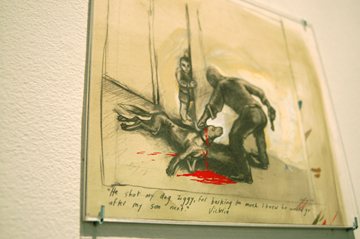
"He Shot My Dog Ziggy" Sue Coe 2006
There is a limp irony in the handshake that pervades deals made and sealed in the art world today; in the midst of so much political unrest, tyranny, and corruption on a global level, there are surprisingly few artists who choose to address these injustices with the honesty and outrage as does artist Sue Coe. Coe intends to illustrate the testimonials of the wronged and the marginalized, the voiceless barers of what most of us tend to ignore.
Her images are illustrative yet not overly didactic; while her message and stance on her chosen subject matter is clear, she does not become a dictator in her world of visions. At once reminiscent of other politically motivated, expressionist influenced artists such as Kathe Kollwitz and William Kentridge,
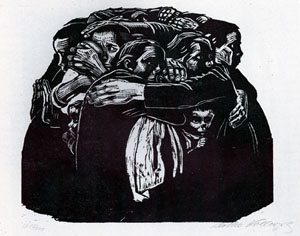
"The Mothers" Kathe Kollwitz 1921/22
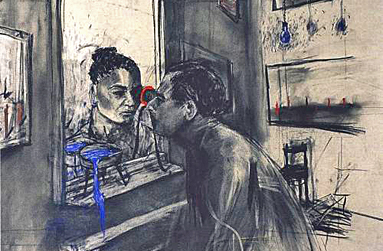
From "Felix in Exile" William Kentridge 1994
Coe's drawings and prints maintain a turgid feeling of urgency and outrage. She cannot seem to execute them fast enough, her intention not at all to immortalize her ego or the level of her sophistication in hours of dedication to an empty, baubled craft, but to portray real life scenarios while inciting her audience. Her methods are simple and unabashed and unafraid in their emotion; she paints her victims with the empathy they deserve while her woodcuts belie her sense of outrage in a more direct fashion. The act of the printmaking itself does away with the needling of the graphite in its effort to form. In the prints the lines are there and they aren't, the world in black and white, the way it is, so to speak, in Coe's perception. The woodcuts are Coe's own violent retaliation.
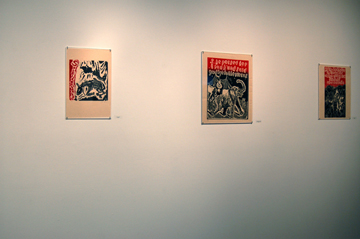
Installation Shot PNCA: "Sue Coe: Graphic Witness" 2006
Coe's is a forum and conversation that is surprisingly rare. The rampant contemporary horrors she chooses to address are pressing and resound through the marrow of our culture yet go largely unaddressed. This silent tendency raises yet another dangerous newborn current in the trends of culture and politics: the consequences of "political correctness". In the effort to become more culturally sensitive and empathically aware, we seem to have lost the ability to say anything for fear of violating someone, somewhere or perhaps be ignorantly pigeonholed and thus somewhat silenced. Thought becomes an endless philosophical dilemma without much resolution or direction, and in the end the biggest culprit is fear. Of course society fears the unknown, the villain, that which is not itself. Yet what we seem to fear even more so in our era of political correctness is to have our own misgivings actually shown to us or discussed. This sentiment and phenomena most prominently exhibits itself in Coe's piece "Prison Journal: Michelle Panther Story" in which Coe represents a caged panther roaring in front of an audience of faces distorted in horror. Coe's text below the image is a testimonial of one young woman's gift of pet panthers as a child, a male and female. The female became pregnant and was accosted by authorities. When the male became aggressively protective, he was shot. The female thus became aggressive and was also shot. The fetus was cut from her womb and the resulting panther was the one portrayed in Coe's drawing, roaring at the crowd. This was the most disarmingly poignant piece of Coe's for me personally, as I believe it to have relayed society's fear of itself. A sort of Frankensteinian fable, this work kaleidoscopically portrays society's absolute terror at seeing the things it is and has done. While Coe continues a long tradition of politically and socially motivated artists, she is relatively alone in what she does today. She is the the voice of the voiceless in an era of noise, undaunted in her efforts in the war on silence.
Thanks for signing in,
. Now you can comment. (sign
out)
(If you haven't left a comment here before, you may need to be approved by
the site owner before your comment will appear. Until then, it won't appear
on the entry. Thanks for waiting.)