|

|
|||
|
Portland art blog + news + exhibition reviews + galleries + contemporary northwest art
|
||||




Diana Puntar's An Hour On The Sun at small A 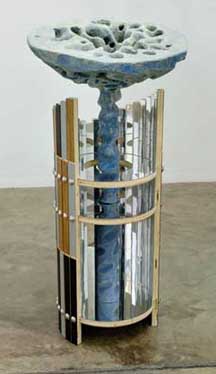
Puntar's A Moment Too Soon (2006) Americans are famously materialistic so it's no surprise that American art has a long tradition of material fetish as carrier of information, although it certainly popular in other countries as well. Be it John Chamberland's crumpled cars, Warhol's Gold Marilyn, Carl Andre's bricks, Jeff Koon's vacuum cleaners, Damien Hirst's carcasses, Dieter Roth's chocolate, Yves Klein's blue pigment, Matthew Barney's Tapioca, Tara Donovan's stacks of cups the material is the engine that drives or at least directs the message. More recently artists like Roxy Paine, David Altmejd or Curtis Fairman have all presented strong bodies of work exploring paint, mirrors and the world of store-bought plastic as well. Locally we have Chandra Bocci, Jacqueline Ehlis, Jesse Hayward, Brenden Clenaghen etc., the list is never-ending. To this list lets add Diana Puntar at small a projects, it's he last day of her show and her materials are decidedly mid-century sci-fi. Her favorite material is plywood, used in a way mid-century design fanatics will be very comfortable with. From Frank Lloyd Wright to Charles and Ray Eames it is as synonymous with modern furniture as metal tubing and glass. In step with the fetish Puntar often laminates mirrors to the plywood as well. This all relates back to a time when the future wasn't quite as complicated (save for Earth's annihilation by nuclear weapons). The extensive use of mirrored plywood slats also serialize space with facets while evoking sputnik era satellite design. It's slightly Alvar Aalto but no where near as refined and some of the plywood edges wouldn't have made his grade. Still, this isn't furniture and instead of architecture should be compared with early sci fi set design. Puntar's work is more Doctor Who and Logan's Run than the elegant curves of Aalto. In works like "A Moment Too Soon," the campy suspension of futuristic disbelief is ripe for the taking. The circular slatted and mirrored pedestal is sprouting a slightly sparkly green organic structure that reassembles a seed case and an organic satellite dish. Is this some alien invasion or has Verner Panton's camp melded with an Eames-ish aesthetic? The effect is humorous tension that reminds me of the best Dr. Who episodes, a futuristic world of robots that look suspiciously like garbage cans. The camp comes full circle when the lights are turned off only to reveal the object glows in the dark. The fact that I can see how the foam was carved and not "grown" only furthers the sense of sci fi set design. 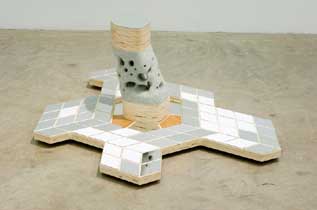
Last Thing I Remember (2006) Other works like "The Last Thing I Remember" leave no doubt that this is an ode to B-grade sci-fi dialog, but to what end? I'm geeky enough to connect it to shows like Space 1999 or Jason of Star Command but is this just pandering to the other Paul Allen's of the world? 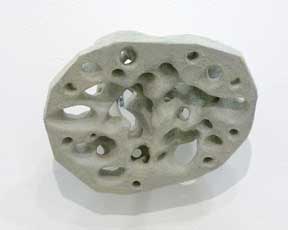
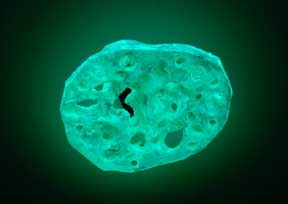 Untitled (lights on and off) I liked the back room better as the gimmicky fluorescent paint gag had more complete darkness. I also preferred it because the show's title piece, "An Hour On The Sun" seemed to evoke an impossible enterprise. Although visually less unique, the work's size was larger than a human as suited to the title's task. At this point in the show I decided this wasn't just prop art. Still except for the very weird "Untitled" the fluorescence seemed like a gimmick. Somehow having glow in the dark rocks during the 70's in my toy collection made this trick seem superfluous. It isn't Keith Sonnier and it doesn't have the wonder of those cheesy mall stores where you can buy lava lamps. In the end I felt like this work was still in transition. It was enjoyable but it is no where near as funny or inventive as Curtis Fairman but it has a similar type of appeal. It needs to embrace the stagecraft of installation art and become as big a scene stealer as Shatner to really take off. Right now this is just Chekhov at the helm of this art "wessel." Overall, if the material is cheese, serve it up in bigger slices. small A projects 1430 SE Third Portland, Oregon 97214 Posted by Jeff Jahn on November 11, 2006 at 13:26 | Comments (0) Comments Post a comment Thanks for signing in, . Now you can comment. (sign out)
(If you haven't left a comment here before, you may need to be approved by
the site owner before your comment will appear. Until then, it won't appear
on the entry. Thanks for waiting.)
|
| s p o n s o r s |
 |
 |
 |
|
 |
|
 |
|
 |
|
 |
|
 |
|
 |
|
 |
|
 |
|

|
Site Design: Jennifer Armbrust | • | Site Development: Philippe Blanc & Katherine Bovee | |