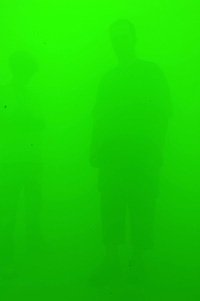
Ann Veronica Janssens , Installation view L E E 121 !
Courtsey Galerie Micheline Szwajcer, Anvers
(c) Biennales de Lyon 2005, Photo: Blaise Adilon
On the 2005 Lyon Biennial
One could argue that the popularity of art fairs, biennials and newly minted MFA grads all has to do with a common desire: an obsession with the new and the now. In the midst of this frenzy for all things emerging, the 2005 Lyon Biennial – entitled Experiencing Duration - rejects a typical biennial's premise of surveying the present, creating a kind of anti-institutional anti-biennial. Curators Jérôme Sans and Nicolas Bourriaud collapsed distinctions between art of the late 60 and 70s and art of the past two years, disarming temporality of its authority in order to clear the way for re-imagining the future of art.
When post-modernism descended onto the art world and passed through a generation of art students who would later become teachers in these same institutions, it left the artist without the possibility to fantasize about anything resembling utopian ideals. Sans and Bourriaud are particularly interested in hippie idealism, except they are fully aware in the inability to believe in utopia. Relieving the artist of the quest to re-imagine the world in utopian terms, Sans and Bourriad instead seek to regain the experiential optimism and energy of this era without the delusion of utopia. At the same time, they are interested in no less than to foster a new environment for the younger generation of artists, one that reclaims an idea of sustainability and breaks away from a cycle of simply identifying and "consuming" the new.

Erwin Wurm, Detail of Adorno was wrong with his idea about art
Courtesy Galerie Krinzinger; Galerie Anne de Villepoix et Galerie Xavier Hufkens
(c) Biennales de Lyon 2005, Photo: Blaise Adilon
Curators and institutions are almost always playing catch-up with the artists whose work they exhibit. Institutions move slowly. Centre Pompidou was, for example, displaying its Permanent Collection out of its normal chronological order for the first time in history, breaking away from a chronological narrative of artistic movements that speak of Modernism, to a postmodern leveling of work into rather arbitrary, loosely related thematics. Sans and Bourriaud, though able to craft a substantially more nimble institutional model during their tenure at Palais de Tokyo (soon coming to an end with the appointment of the Swiss Institute's Marc-Olivier Wahler as new director), still remain indebted to the institutional infrastructures that support their position as curators. Their response? To create a biennial in which they adapt the strategies of artists. Curator becomes a source for re-contextualizing the historical terrain and challenging the institution, in the process shaping conditions for the next generation of artists.
It's not so far away from the sillier parts of the interview in this month's Artforum with the 2006 Whitney Biennial curators, Chrissie Iles and Philippe Vergne, in which they discuss the creation of a third imaginary curator, Toni "with an i" Burlap. Artists have long been working with fictional identities as a way to challenge institutions and a number of these artists are included in the biennial. Vergne nakedly states that the reason for their decision to adapt this strategies is to "complexify."
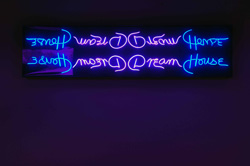
La Monte Young and Marion Zazeela, Detail de Dream House Sound and Light Environment a time installation measured by a setting of continuous frequencies in sound and light. The Prime Time Twins in The Ranges 576 to 448; 288 to 224;144 to 112;72 to 56;36 to 28; with The Range Limits 576, 448, 288, 22
Courtesy La Monte Young et Marian Zazeela. Avec le soutien de Focal JMLab
(c) Biennales de Lyon 2005 Photo: Blaise Adilon
Bourriad and Sans "complexify" the notion of a biennial by including work from the 60s and 70s, challenging assumptions about what defines now. There is an obvious tension between the underlying ideals of work such as LaMonte Young and Marion Zazeela's meditative environment, Dreamhouse, or Tony Conrad's Yellow Movie series, which treats the yellowing of paper over time as a kind of slow moving filmic experience, and the work of younger artists, like Saâdane Afif, who exhibited a room full of white, auto-playing guitars that intermittently play power chords. The younger generations tend towards spectacle without shame, but perhaps laden with a heavier dose of cynicism.
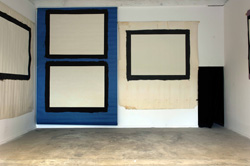
Tony Conrad, Installation view Yellow movies
Courtesy Tony Conrad
(c) Biennales de Lyon 2005 Photo: Blaise Adilon
The emblematic piece of the show was perhaps Ann Veronica Janssens' green-hued, fog-filled room. Employing a smoke machine, a small gallery space was converted into its opposite, rebelling against its institutional setting by dissolving museum walls, inverting the expectation of looking by creating a space shrouded by visual obscurity and breaking codes of conduct by encouraging anonymous social encounters. It was one of the most popular pieces in the show (the other being Martin Creed's funhouse of pink balloons), luring people not only with spectacle, but the potential for reclaiming a sense of discovery within the institutional realm.
Report From France: Part I (Nature)
Report From France: Part II (Fictional Geographies and Disorientation)