|

|
|||
|
Portland art blog + news + exhibition reviews + galleries + contemporary northwest art
|
||||




New Found Land - Cynthia Lahti at PDX Cynthia Lahti's new work at PDX Contemporary Art is a body of ephemeral ink drawings and delicate sculpture. Lahti creates work that is consciously fragile. The drawings look less framed and more contained; as one would preserve and display an exotic butterfly.
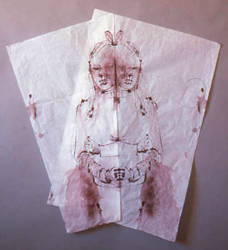
brown bow Lahti's drawings are mostly composed around a butterfly-like symmetry. She draws in ink on tissue paper and folds the paper in half through the drawing. The ink so saturates the paper that it tends to destroy it, in addition to bleeding out in near uncontrollable directions. Lahti chooses subject matter she responds to emotionally from diverse sources. Mostly the images seem to come from magazines and deal with nostalgic representations of idealized childhood. Lahti's drawing method is uncorrectable, she must accept errors as compositional devices or throw the drawing away. Further, Lahti seems to relish the idea of error as an artistic device. The inclusion of error in an artist's program generates unsettled objects. Lahti's drawings (as well as her sculpture) are on the way to completion, but never arrive. The object is in transit; almost, but not quite yet, a drawing. The elegance of the drawing has been overmastered by the brutal, stupid force of her main compositional solution: folding the drawing in half to create a Rorschach test. Symmetry provides the looked for solution; indelibly solidifying the image. 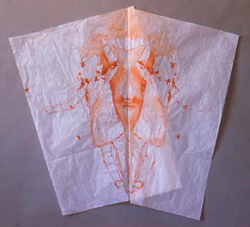
Spin Symmetry stills the motion of the unfinished drawing and introduces layers of meaning unrelated to the subject matter. Images of idyllic childhood fancy are multiplied, corroded, frozen and preserved by the symmetry. Lahti's Rorschach test acknowledges that childhood was an ego-constructed fantasy after all, but nevertheless one worth preserving. Ultimately, Lahti's work speaks to the fragility of the ego itself, as well as the often transparently superficial means by which it composes and constructs memories. It is with extreme selectivity that the adult mind sifts through the experiences of childhood, emphasizing episodes relevant to the self it now envisions, discarding those which dissemble or diverge from the meaning it has decided upon. Lahti reveals this selection process as totally arbitrary. She chooses images to symmetricalize and thus assert and preserve, falsely attaching them to the interconnected lattice of memory. The strangest effect of Lahti's symmetricalization is the identity principle created between the image and its double. Memories work through interconnection, but Lahti's program attaches the images to their mirrors, the drawings become self-referential, complete systems. Lahti's images subvert the process of memory construction by connecting only to their doubles. The image is the image, and it exists outside of the larger structure of memory, an end unto itself. Perhaps this is why biological systems are always symmetrical, they are complete, perfect, and this perfection easily registers visually in the human mind. Most religious iconography is composed symmetrically to convey ideals of perfection. It is strange to think that those ideals precede the subject and are embedded in the composition itself. It is almost as if the same ideals could be communicated without any representational imagery. Thus our attraction to the butterfly, our immediate recognition of the Rorschach blots as communicative imagery. Lahti uses symmetry to perfect and preserve unfinished drawings full of errors and unintentional marks. The action of drawing disintegrates the paper. It is as if she is reaching beyond the object, for something less solid, futilely trying to pull a thought or emotion into the physical world. 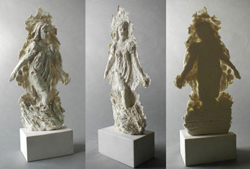
The Path Where she doubles her two dimensional work, she halves her three dimensional work. The small sculptures in hydrocal and glass stand upright on pedestals as sculpture in the round, but are finished only on one side, as relief detached from the support of a wall. In parts they become excruciatingly thin. A lovely moment occurs in The Path, where a young girl walks purposefully through a grassy field, surrounded by a mandorla of what appears to be flame, but could be simply excess hydrocal which Lahti chose not to cut away. The hydrocal is so thin that it is very nearly transparent, and looking at the statue from the back, the silhouette of the girl remains dark as her thin aura is lit up by the gallery lights. In her sculpture, Lahti's themes remain consistent: experiences half remembered or constructed, unfinished objects, things on their way to being, preservation, delicacy to the point of unreality, childhood as manufactured by the consciousness of an adult. Cynthia Lahti • New Found Land • New sculptures and drawings • December 6 - 31 • PDX Contemporary • 925 NW Flanders St • Portland, Oregon 97209 • (503) 222-0063 • Posted by Isaac Peterson on December 21, 2005 at 8:22 | Comments (0) Comments Post a comment Thanks for signing in, . Now you can comment. (sign out)
(If you haven't left a comment here before, you may need to be approved by
the site owner before your comment will appear. Until then, it won't appear
on the entry. Thanks for waiting.)
|
| s p o n s o r s |
 |
 |
 |
|
 |
|
 |
|
 |
|
 |
|
 |
|
 |
|
 |
|
 |
|

|
Site Design: Jennifer Armbrust | • | Site Development: Philippe Blanc & Katherine Bovee | |