|

|
|||
|
Portland art blog + news + exhibition reviews + galleries + contemporary northwest art
|
||||




Mona Hatoum at Cooley
Although comprised of object-based work ranging from large-scale sculpture to delicate waxed paper impressions, Mona Hatoum's work at the Cooley Gallery revolves around a desire to craft encounters - sometimes uncomfortable - between viewer and object. A contemporary of the YBAs, Hatoum shares only marginal similarities to the shock tactics of her pop culture obsessed peers. Hatoum's mode of working deals with personal, political, visceral and violent content through conceptually-driven art that rests on a solid foundation of formal consideration of how her practice manifests itself within the gallery. Her work bears more resemblance to 80s era Rosemarie Trockel or Christian Boltanski than to Damien Hirst's perversions of minimalism or Sarah Lucas' general bawdiness.
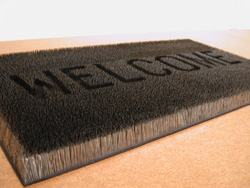
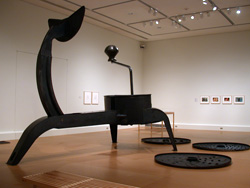
The ominous profile of La Grande Broyeuse - literally, the big grinder - dominates the gallery. This major piece is an impressive inclusion in the Cooley's modestly scaled gallery and provides a key visual and conceptual foundation that informs the entire exhibition. It is at once threatening and playful. Manifesting itself through high and low, sublime and mundane, La Grande Broyeuse speaks to a lineage of modernism, yet doesn't stray far from the personal and geopolitical themes that emerge repeatedly in Hatoum's work. The French title brings to mind the lingering presence of French influences in Lebanon, where Hatoum was born, but more importantly, references Marcel Duchamp's lingering influence in contemporary art. Both form and title recall Duchamp's iconic la Broyeuse de chocolat. The cavity of Hatoum's grinder is large enough for a human body, and the sculpture at times seems like a threatening insect-like torture device. Yet, it's at root a humorously glorified utensil, based on an archaic grinder from the kitchen cupboards of the artist's mother. A more contemporary counterpoint can be found in its resemblance to the monumental geometries of industrial male sculptors like Mark di Suvero and Anthony Caro. La Grande Broyeuse forms a complex of meanings, but handled within the scope of Hatoum's sharp practice, these meanings avoid becoming convoluted, instead, neatly intersecting through the formal qualities of the sculpture itself. Doormat toes a similar line between direct experience and historical associations. Large blocky letters announce the word "welcome" across what appears to be a commonplace black rubber doormat, but upon closer inspection, the object is revealed to be made of thousands of pins pointing up towards the viewer. This encounter between the object and the viewer incites simultaneous reactions of attraction for the precisely crafted object and cautious aversion from its potentially painful surfaces, recalling Meret Oppenheim's fur-lined Surrealist teacup. Doormat also harks back to one of Hatoum's first major pieces, The Light at the End, which beckoned viewers to the back of a dim gallery space with glowing heating elements, playing on similar tensions between desire and danger, perceptual and visceral. Doormat also speaks to the condition of exile, placing the viewer at the doormat of an imagined doorway welcoming one into potentially threatening terrain. As curator Stephanie Snyder writes in the catalog that accompanies the exhibition, it provokes an awareness that "nowhere, or somewhere else, can be a very uncomfortable, even deadly, place to be." Many of Hatoum's works hinge on a simple premise of unexpected materiality. Hers is a world where one discovers that rubber bristles are steel pins and harmless kitchen objects morph into weapons. The pieces avoid becoming a one-liner because of Hatoum's continual return to an ever evolving set of issues as well as her success in translating idea into object.
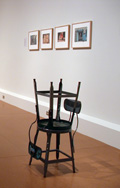
Two works included in the Cooley exhibition from Hatoum's Sprague Chairs series are less successful in their ability to seamlessly meld concept with object, primarily because they depend on a subjectivity and overt manipulation that is less apparent in other work. Each work in the series is comprised of two metal chairs reclaimed from a defunct factory, stacked atop one another in an ad hoc workingman's monument to loss that also bears resemblance to Duchamp's Bottle Rack. The copper wire that secures the chairs together is used to spell out words like "Laid Off" and "Dismissed," lending the pieces a sentimental poetry that over-emphasizes the already obvious connotations of these objects. Hatoum's work is most successful when it appears effortless, defying the focused conceptual and aesthetic consideration that she devotes to each piece. Hatoum often uses the potential for danger to reference the body - electrified wires, sharp edges - but several pieces in the exhibition make a direct correspondence between the physical world and its two-dimensional rendering. A pair of etchings are created from placing tangled strands of hair directly on the zinc plate, creating a delicate and arbitrary pattern of lines. Hatoum is also interested in how objects, especially those with links to her sculptural work, can be represented through artifact. Several delicate works are created by pressing wax paper over the hard edges of Amish kitchen utensils, creating a ghostly abstraction of knives and colanders. As viewer and critic, one is tempted to view Hatoum's work solely through the lens of her identity as a Lebanese woman of Palestinian descent living in London, eschewing her ongoing dialog with Modernism and her ability to continually evolve her work. In pieces like Keffieh and Measures of Distance, which more overtly references Lebanese and Palestinian cultures, Hatoum continues to engage in a relationship between concept, viewer and object. In Keffieh, an intertwining pattern of long hair adorns a traditional Arab headscarf, inverting the normal relationship of body to clothing in the same way that it inverts the relationship of the female body to the public, masculinized space. Walking through the exhibition of Hatoum's work, it becomes apparent that to give in to a purely feminist or Orientalist reading of the work would be reductive. The viewer must be willing to follow Hatoum into an ever-evolving practice, sometimes at the risk of discovering that they too have wandered into unfamiliar aesthetic and intellectual terrain. Through December 23 • Cooley Art Gallery All images are authorized for use on PORT only and should not be used for any other purpose. Posted by Katherine Bovee on December 22, 2005 at 8:05 | Comments (0) Comments Post a comment Thanks for signing in, . Now you can comment. (sign out)
(If you haven't left a comment here before, you may need to be approved by
the site owner before your comment will appear. Until then, it won't appear
on the entry. Thanks for waiting.)
|
| s p o n s o r s |
 |
 |
 |
|
 |
|
 |
|
 |
|
 |
|
 |
|
 |
|
 |
|
 |
|

|
Site Design: Jennifer Armbrust | • | Site Development: Philippe Blanc & Katherine Bovee | |