|

|
|||
|
Portland art blog + news + exhibition reviews + galleries + contemporary northwest art
|
||||




Mapping Sitting at the Cooley
Walid Raad, one of the two artists behind Mapping Sitting, is best known for his ongoing project documenting the history of Lebanon through videos, photographs and original documents. Working under the guise of a fictional non-profit collective, The Atlas Group, Raad freely intermingles historical fact with fiction, introducing fictional figures and experts within his retelling of Lebanese contemporary history. For Raad, who prefers to call The Atlas Group an imaginary foundation rather than a fictional entity, the insertion of these fictions alongside historically accurate documents and accounts is a way to open up multiple routes of access and introduce a multiplicity of discourses previously unheard in mainstream media and established academic versions of history. Although the contents of Mapping Sitting, unlike Raad's work as The Atlas Foundation, are historically correct, the exhibition also deals with the question of the malleability of historical retelling. Raad and collaborator Akram Zaatari, a filmmaker and co-founder of the Fondation Arabe pour l'Image (FAI) in Beirut, drew from the archives of the FAI to create a survey of Arab photographic portraiture from the last century.
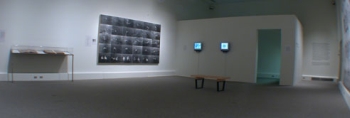
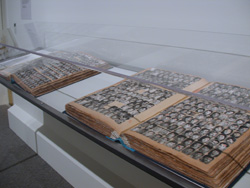
The photographs included in the exhibition provide a rare look into the quotidian affairs of Middle Eastern communities at a time when modernization was drastically changing the daily lives of people. The commercial origins of these photographs are emphasized by repetition and inclusion of documentation used in professional studios, such as the identity books that were used to keep track of clients. One series shows a number of individual subjects posing atop the same outcropping of sharp rock in front of a picturesque shoreline. Another is comprised of a series of individual portraits of Muslim Boy Scouts riding a ski lift on a summer visit to a Lebanese ski resort in the 1950s. A video montage of spontaneous street portraits that derived from the French tradition of photo surprise attest to the presence of commercial photograhpers within the fabric of urban life. The most visually striking piece in the show is a display of thousands of small identity photographs used for passports and official documents that stretch across one wall in a neat grid. Mapping Sitting forms an interesting pairing with the previous exhibition at the Cooley Gallery, Snapshot Chronicles, a survey of early American photo albums. Both use historical documentation of everyday lives that provide access to larger social forces and historical contexts, although the geographic origins along with the contrast between the amateur photography documented in the Snapshot Chronicles and the formalized commercial portraiture of Mapping Sitting open up a very different set of questions. The photographs of Mapping Sitting are striking for the very fact that they are rooted in everyday life instead of the volatile political landscape so frequently conveyed by Western media both historically and presently. Looking at the photos, one sees a thoroughly modernized and Westernized population and questions of how much these photos reveal about the accessibility of professional portraiture, what they reveal about the social standing of their subjects, and how much they reveal about the lingering influence of Western photographic tradition introduced to the region in the mid-19th century are never completely answered. The aim of Raad and Zaatari are not to give a definitive historical account of this collection of photographs, but to prompt a line of questioning about how these portraits functioned historically within the Middle East and how they function for viewers within the context of contemporary art. Over the past several decades, and particularly within the past several years, contemporary art from and about Arab cultures has been giving increasing prominence and coverage. But, contemporary art, much like mainstream media, continues to fuel a largely exoticized image of Arab culture, as Middle Eastern art is most often rooted in politics. Although this show is in no way devoid of politicized themes, especially given the scope of Raad's ongoing work, Mapping Sitting disrupts our expectations by presenting a mundane and personalized account of Arab culture throughout the 20th century. Through September 30 • Cooley Art Gallery Posted by Katherine Bovee on August 30, 2005 at 9:47 | Comments (0) Comments Post a comment Thanks for signing in, . Now you can comment. (sign out)
(If you haven't left a comment here before, you may need to be approved by
the site owner before your comment will appear. Until then, it won't appear
on the entry. Thanks for waiting.)
|
| s p o n s o r s |
 |
 |
 |
|
 |
|
 |
|
 |
|
 |
|
 |
|
 |
|
 |
|
 |
|

|
Site Design: Jennifer Armbrust | • | Site Development: Philippe Blanc & Katherine Bovee | |