|

|
|||
|
Portland art blog + news + exhibition reviews + galleries + contemporary northwest art
|
||||




Interstate Out of August's first Thursday crop of exhibitions, Dan Gilsdorf's Interstate emerges along side of Bent as the best of downtown.
Interstate is a show of kinetic sculpture and installation. Described by the artist as "mechanical simulacra as homage to human consciousness." Militaristic machines cycle through futile movements. Two rows of army boots stomp up and down in place, setting a plodding rhythm in the center of the gallery. A motor driven brush scrubs the eyes of a plaster head. Tiny, repetitive motorized sculptures project huge shadows on the wall, creating moving dioramas of banal American landscapes. Gilsdorf draws imagery from his own experience: telephone poles passing through the headlights of a westbound car, oil towers looming over the plains, the adolescent emulation of military heroism. 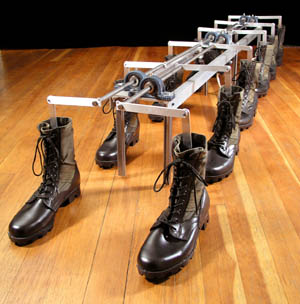
Gilsdorf examines the relationship between culture and the consciousness of the individual. He concentrates on the fictions culture creates which shape the development of the psyche. Gilsdorf's work is highly ambitious, he reaches for universal descriptors for the cultural framework, as well as for the intricate details of personal experience. He examines how individual actions and events, when attached to values seen as universal, enlarge to become history, which by definition contains fictions. In order for the present to become processed into the past, it must be fictionalized. Gilsdorf scrutinizes heroism as exemplified by the military, sifting through fictions in pursuit of the true American mindscape. In these pieces it is as if the viewer is projected into male adolescence, idolizing the imagery of the military without understanding it. Simple machines simulate military efficiency while simultaneously revealing its philosophical futility. Gilsdorf reduces the heroism of action to limited, futile cycles which repeat interminably. Gilsdorf's mysterious objects bring up too many complex associations to be seen as simply a critique of the military. The subject matter is instead the internalization of heroism, and the negotiations that occur between cultural ideals and the futility of actual experience. One untitled piece succinctly and strikingly examines the excesses of masculine culture. Rubber tubing describes the outline of a screaming eagle, diving with claws outstretched. Although the silhouette is difficult to precisely place, it is one that you've seen thousands of times, as a patch on a jacket, as a decal, as a trucker hat. Oil is pumped through the tubing and leaks out onto the wall in long streaks, draining back into a reservoir beneath the piece. It is the perfect emblem for the vanity of the American consumer, wasting resources as a display of wealth. It exposes the debauchery of the American male ego, but also elegizes its heroic aspirations. 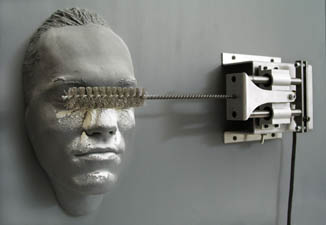
Centurion deals with culture as a dehumanizing process. A mechanical lever causes a brush to slowly erode the features of a plaster face. This piece is the most overt, and engages a direct brutality that is elsewhere sublimated into more complex associations. One particularly powerful and complex piece, Slugger, generates multiple levels of meaning through poetic association. A giant canvas in the center of the gallery is painted with broad red, yellow, and green vertical stripes. The colors and placement of the stripes relate to the ribbons on medals given in Vietnam. A motor drives a crankshaft attached to a Louisville Slugger, which traces a misshapen ellipse low in the center of the painting. The striking surface of the bat has been burned to charcoal, and carved into a point. The burned bat draws the ellipse onto the canvas over and over, automatically, ad infinitum. The associative imagery in Slugger is neural rather than subject specific. Only in the mind and experience of a specific individual could military heroism, baseball, and heroic painting all merge into one object. What we are looking at is a record of the changing consciousness of an adolescent male, as he negotiates the gap between heroism and play, and between art and war. Gilsdorf sees war and history itself as a theatre which imprints consciousness. Gilsdorf imagines the mechanisms that produce these fictions as bombastic and gratingly self-destructive and suggests the possibility of seeing events as they actually occur, rather than through the filters history presents. This work seems especially resonant in our current area of simulated history, in which events are historicized while they are happening. The danger of historicizing the present is that events taking place are treated as if they have already occurred. There is a deep despair in that inevitability, the despair of an automaton grinding itself apart in a repetitive circle. Broad in scope and nuanced in detail, addressing the complex interaction of history, society and the internal life of the individual, Interstate is a must see by one of Portland's most promising emerging artists. Exhibition Dates: August 3rd - 27th, 2005 GALLERY 500 420 SW Washington St. Suite 500 Portland, Oregon 97204 503.223.3951 http://www.gallery500.org tuesday-friday 11a-5p, saturday 12p-6p Posted by Isaac Peterson on August 09, 2005 at 1:32 | Comments (0) Comments Post a comment Thanks for signing in, . Now you can comment. (sign out)
(If you haven't left a comment here before, you may need to be approved by
the site owner before your comment will appear. Until then, it won't appear
on the entry. Thanks for waiting.)
|
| s p o n s o r s |
 |
 |
 |
|
 |
|
 |
|
 |
|
 |
|
 |
|
 |
|
 |
|
 |
|

|
Site Design: Jennifer Armbrust | • | Site Development: Philippe Blanc & Katherine Bovee | |