|

|
|||
|
Portland art blog + news + exhibition reviews + galleries + contemporary northwest art
|
||||




Justine Kurland at PICA by Isaac Peterson 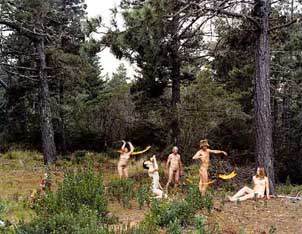 Fire Eaters by Justine Kurland Five large photographs by Justine Kurland occupy a central wall and a corner space in the lobby of the Weiden and Kennedy building near the PICA reception desk. It is unfortunate that this work is displayed in such an easy to walk through area, as the meditative atmosphere Kurland creates would be better suited to a space less bustling. It is easy to see the relationship between Kurland's mythic natural settings and the work of her former Yale teacher, Gregory Crewdson. Kurland walks a tightrope stretched between the mythical and the everyday, and allows her images to be pulled sometimes completely toward myth, while maintaining a slender relationship with the regular practices of "nature as spirituality." At other times, the imagery is pulled too far back to the familiar Oregon outdoor culture, and the larger implications must be sifted out of what is immediately identifiable as a typical camping weekend in Oregon. 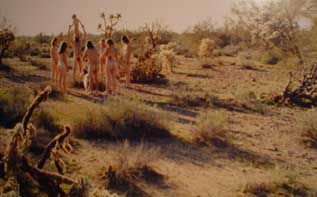
Round Circle (detail) Round Circle is a glorious desert landscape shot during a sunset (or sunrise?) with dynamic, elongated shadows that reach back toward a circle of nude celebrants. One's initial interest in the majestic landscape and the activity taking place within the circle almost immediately fades to be replaced by a sense of menace. The figures seem fragile and out of place in a harsh environment. What are they doing there anyway? The activity seems less like a casual celebration and more like a fertility ritual. The circle is comprised of only two men, and a number of women. Round Circle pulls convincingly "normal" imagery into the realm of the allegorical, of the archetypal. Are we viewing a morning meeting at a nudist camp, or a pagan bacchanal or perhaps both at once? One of the only fully clothed figures in Smoke Gathering is an aged guitar player who wears a hat that declares "Will Sing for Cookies." It is only "civilized" culture that looks to nature for transcendence, often recklessly. Primitive people do not consider themselves primitive, nature is their culture. 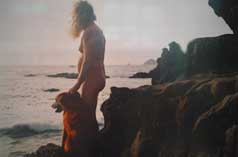 After Blake The culminating piece is entitled After Blake and depicts a white-haired and dreadlocked nude man standing on a rocky sea shore clutching a golden retriever close to him and gazing out into a dazzlingly illuminated Pacific. In this piece the menace of Round Circle and the spiritual diffusion of Fire Eaters has resolved into a profound optimism. Sacrifice, cataclysm, and pagan rituals are unnecessary. William Blake of course, is the perfect avatar for reconciliation of the civilized mind and the visionary experience, and the figure in Kurland's photograph could well be derived from one of Blake's watercolors of God looking out over the void. -Isaac Peterson is a Portland based artist/critic who recently returned to his home city after completing a MFA at the University of Cincinnati. He has published many times in Art Week. Posted by Isaac Peterson on July 18, 2005 at 22:41 | Comments (0) Comments Post a comment Thanks for signing in, . Now you can comment. (sign out)
(If you haven't left a comment here before, you may need to be approved by
the site owner before your comment will appear. Until then, it won't appear
on the entry. Thanks for waiting.)
|
| s p o n s o r s |
 |
 |
 |
|
 |
|
 |
|
 |
|
 |
|
 |
|
 |
|
 |
|
 |
|

|
Site Design: Jennifer Armbrust | • | Site Development: Philippe Blanc & Katherine Bovee | |