The Poet's Nature Lab: Camille Solyagua at Charles A. Hartman Fine Art
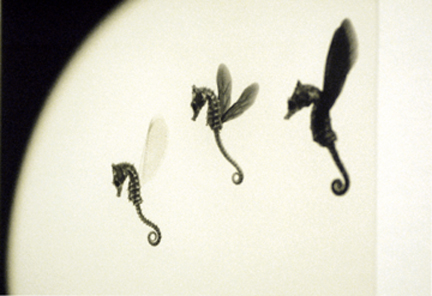
"Three Seahorses" 1998 Camille Solyagua
The birth of a new era is upon us within Portland's Pearl. The opening of the Desoto building this Sunday gathers the forces of a number of the Pearl's galleries in a space akin to airline hangers and origamied kites. Light floods this space and lifts it, and it seems to float just above its foundation with a monumental kinetic potential.
In addition to a number of very present Portland institutions creating the entity that will be the Desoto, a new presence makes its debut this Sunday. The Charles A. Hartman Fine Art gallery opens its doors with a show by Portland based artist Camille Solyagua. Solyagua's work seems an investigation of the metaphysical through an eccentric portrayal of natural systems. Her photographs and photograms hang quietly within the new Hartman space, coincidentally complimenting and challenging the architecture.
The exhibit, entitled 'Collections' is quietly persuasive. Solyagua leads the viewer through the work with the gentle, steady prodding and fascination of a scientist. Her pieces do not need to shout their cause in pomp or self righteousness. They hold their own power as contemporary hieroglyphs for universe. She seems to want to discuss light and the poetics of light: how it defines/delineates space and the objects therein. Are the names we give objects the definitions that suffice? Solyagua introduces us to worlds within these objects she photographs, outlines, lets the sun imprint, and gives us the freedom of namelessness: the way of looking at the world before we believed ourselves to have so much understanding. Her images are delicate, eloquent metaphors.
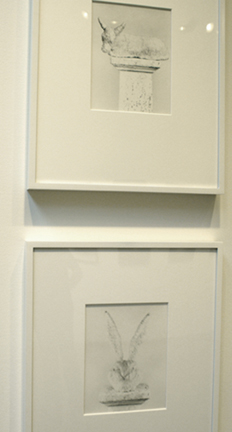
"Enclosed Burro"/"Enclosed Rabbit" 2007 Camille Solyagua
Under a microscope and floating between stars are worlds within which we still search for understanding and words, worlds that are still foreign and of which we are not masters, which we cannot always see and describe and often forget exist. They are beneath and beyond that which is nameable. In these places, a humble silence ensues. Within Solyagua's work the inside of a bird's skull gives us metaphysics, and taxidermy bound in white fluff seems a kaleidoscopic metaphor for eternity. Her droplet galaxies echo our vacuous physical smallness and the incomprehension of our impact. Death is omnipresent within her investigation, not as motivation but as a happening or stage within greater, endless cycles. As the micro versus macro aspects of the work present flip themselves inside out formally and conceptually, the resulting foil destroys any sort of hierarchy one might have previously assigned to the reputations of each respective object. Her collections call to mind the work of Minor White,
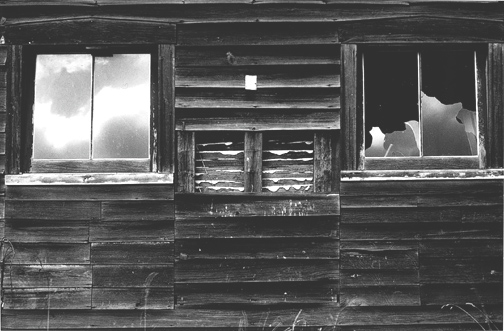
"The Three Thirds" 1957 Minor White
Leonardo Davinci,
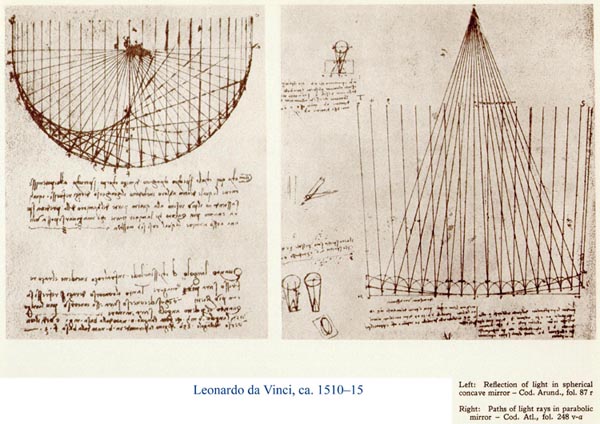
Davinci Drawings from Notebooks ca. 1500-15
and Audubon, all of whom used science as a vehicle to create language.
The unfortunate danger within Solyagua's very poetic metaphorical investigations arise due to the fact that since she gleans her imagery from nature, there is a delicate, yet very present possibility of the overlap into the realm of kitsch or decoration. Her images are not new to our eyes, and she is not the first artist to attempt such investigations. Yet it is not so much each individual picture that relays the efforts of her work; it is the succession of images, the movement between and through the collections that relay her humming goals. Moving from one group of images to the next, the viewer catches him or herself within her experiments, and in many ways, she transforms the gallery into somewhat of a poet's nature lab.
Coming from an academic history in Spanish literature, Solyagua attempts to meld the two mediums of verse and light with her piece "Viente Poemas de Amor y una Cancion Desperada" (Twenty Love Poems and a Song of Despair). This piece formally departs from the rest of the work in the show and seems much more an homage to the late great poet and diplomat, Pablo Neruda than evidence of her own investigation. The title for this piece is also the title of one of Neruda's books, adding further evidence of homage and making Solyagua's condition of awe seem all the more apparent. Here, her hands work literally around Neruda's words, placing his work on an equal plane with nature as awe inspiring entity. Solyagua bases this piece entirely around the poet's verse, working literally around the written lines which she encapsulates into empty pill casings. This piece, while not immediately apparent, actually seems a logical next when considering how Solyagua works; embued with light and an awe inspired humility, these tiny boxes merely continue her ephemeral investigation into forces which she cannot help but pay tribute.
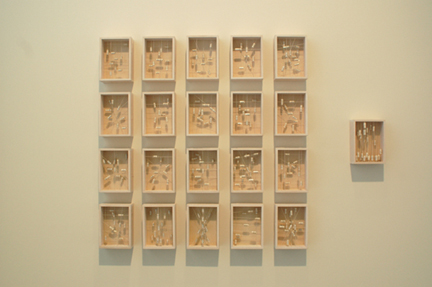
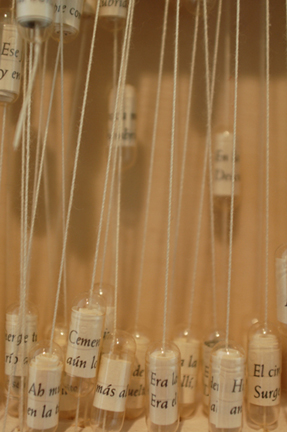
"Viente Poemas de Amor y una Cancion Desperada" 2007 Camille Solyagua
Solyagua's work hearkens back to the diagrammatic efforts of understanding, how physically we can take apart accepted aspects of the world around us, dissect their intricacies and begin to understand their rather kaleidoscopic ramifications. Aligned as poetic portraits, her work is an intimate investigation into the interconnectedness of the natural world and human thought.