|

|
|||
|
Portland art blog + news + exhibition reviews + galleries + contemporary northwest art
|
||||




McGinness at PICA
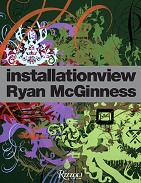
One of the major graphic designers to storm the contemporary art world is New York-based Ryan McGinness, who treated a packed house in the W+K atrium last Thursday to a barrage of slides detailing his work and practice over the past 6 years. A graduate of Carnegie Mellon, McGinness studied in both the design and art programs, but maintained a separation in his mind between his more practical design work with other studio practice. Working at a design firm out of school, he struggled to establish his art practice, until he realized he could drop his pretensions about art making and just begin to make what he wanted to make. At this time, beginning around 1999, McGinness began to use a vocabulary of simplified symbols that show off his masterful design sensibility and ability to pare down complex ideas to their iconographic essence. Over time, he has built up to a more baroque aesthetic, layering symbols and adapting a new lexicon of signs that takes their cue from crests and arabesque flourishes. His installations at Deitch, PS1 and Galerie du Jour in Paris combine wall paintings or vinyl cuts with paintings, sometimes intermingling commercial products as well. Although he has recently returned to using a more simplified forms, he has retained this strategy of exhibiting his work within complex, multi-layered installations. McGinness' work is visually seductive, which is exactly what gives it immediate impact - simply put, it's really sexy work. He imbues his icononography with just enough content to pass muster in the art world, seamlessly intermingling semiotics with art historical references, pop culture and skate culture alike. What's troubling in his work is that he's so dependent on creating complex environments for his paintings and screenprints that function more as a high-end concept store than a gallery installation. It's as if he wasn't quite able to purge his preconceptions about making art vs. graphic design, and still tries very hard to ensure that he finds justification for being included within the art world. Interesting, the result is that one is unintentionally reminded that the gallery houses commodity. Of course, gallery as store is nothing new - we've seen this at least since the 60s and 70s. But what's new is for the artist to completely embrace this model without any sort of critique. His 2003 Deitch installation, Worlds Within Worlds, began to break away from this, but he still seems caught between a desire to create more ephemeral work and a need to create marketable work. When asked about the relationship between his screenprints or paintings and the environments he creates to house them, McGinness explained that the environments are destroyed while the prints and paintings are sold. Do these environments act as anything more than just a slick marketing backdrop that aid the consumer/collector in fetishizing the work? Chiho Aoshima, one of the many talents fostered in the house of Murakami, is also firmly embedded within a graphic design tradition, but I would argue that her installations more successfully act as installations, probably because she treats the gallery as white box instead of a temporary showcase for commodity. This is a question that will continue to define the presence of graphic design in a contemporary art context. But for the immediate future, despite all of this, I must admit I still find myself under the spell of McGinness' visual seduction. McGinness is concurrently showing 3 solo installations at Deitch Projects and Danziger Projects in New York, and PUBLICO in Cincinnati. His exhibition at Deitch Projects is accompanied by a new publication of the same name, installationview. If you weren't one of the lucky few to pick up your advance copy at the lecture, you can find them at Powells beginning November 1. Posted by Katherine Bovee on October 31, 2005 at 9:08 | Comments (2) Comments I agree that I find his distinction between his design practice and his art practice untenable. As far as I could tell his only distinction was that design is a service industry (for another), whereas his art is purely self-indulgent (or to service his own needs). Mostly I was amused by his anecdote where he denied MTV access to his Deitch space, fearing that his installation was going to be co-opted to boost MTV's street-cred/hip factor - excatly how does this differ from giving a talk in the W + K atrium surrounded by nike and adidas designers? I attended the talk hoping it would redeem my opinion of his work (I've seen several installations in person), but now more than ever it seems to function merely as design-porn. Posted by: thereal I disagree with your call Thereal. How does not letting MTV co-opt his art compare with his talk? Well, his talk was put on by PICA, not W+K, in fact, I don't think there was any billing about W+K in the material on the talk at all... and of course the audience of a guy who works in the space between art and design is going to be heavily attended by design focused people... So the difference is that two are totally unrelated. I don't know that the argument of "what is art" has ever really been a very constructive conversation. More insightful would be to simply accept that it is art and then argue over the art itself. I think his work speaks a lot to a younger generation that is very aware of design elements. (maybe over-aware?) We're bombarded with design to the extent that certain fonts and even ascii characters carry a lot of meaning. Especially the web-savvy! We are hyper-tuned to design, and online the design of things replaces seeing that thing in person. I interact with a lot of people I will probably never meet and when I imagine them I think of them as the colors of their blog or the image of their chat avatar. Obviously as one of these web-focused people who really enjoyed the work (but found his presentation a bit dry) I felt like I got a lot out of it, and I'm glad to see a "designer" establishing himself in the world of art. Posted by: kmikeym Post a comment Thanks for signing in, . Now you can comment. (sign out)
(If you haven't left a comment here before, you may need to be approved by
the site owner before your comment will appear. Until then, it won't appear
on the entry. Thanks for waiting.)
|
![[TypeKey Profile Page]](http://www.portlandart.net/nav-commenters.gif)
| s p o n s o r s |
 |
 |
 |
|
 |
|
 |
|
 |
|
 |
|
 |
|
 |
|
 |
|
 |
|
 |
|

|
Site Design: Jennifer Armbrust | • | Site Development: Philippe Blanc & Katherine Bovee | |