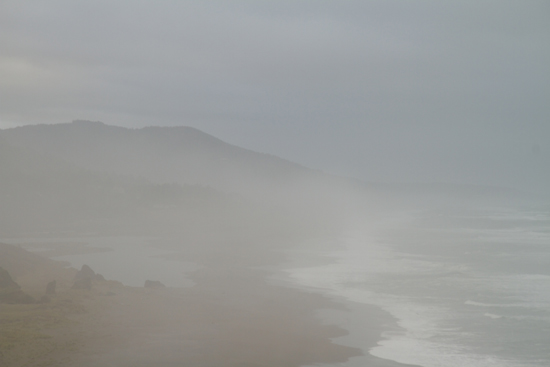
Matt McCormick, "The Oregon Coast," 2011, C-print
I've lived in the Northwest since infancy, raised among its persistent rains and startling sunsets, dense wildlife and endless trees. Now for the first time, I'm on the cusp of a probable move away from my beloved Cascadia. So it was particularly poignant for me to settle into the couch in Matt McCormick's studio to watch
The Great Northwest, a 75 minute ode to change, timelessness, natural beauty and the intangible experiences that define this region.
Matt McCormick, video grab from "The Great Northwest"
The project was inspired by a scrapbook that McCormick discovered in a thrift shop. The book, dated 1958-59, follows the 3,400 mile road trip taken by four female friends in their mid-30s from Seattle. They obsessively documented their adventures, preserving everything from fishing photographs to the labels peeled off their many beers. Using the scrapbook, McCormick was able to reconstruct the friends' travels through Washington, Idaho, Montana and Oregon.
The artist set out to compare what had changed and what had stayed the same.
The Great Northwest begins in Seattle, where McCormick films places visited by the women at the outset of their trip. He frequently holds vintage photographs from the scrapbook in front of the camera, pulling them away to reveal the same scene, 50+ years later. The ploy flirts with feeling like a facile way to make his point, but McCormick's beautiful cinematography saves it. He offers long, slow, photographic shots that almost seem to freeze these elegant moments in time - again.
McCormick's choice to avoid verbal explanations also softens the potentially gimmicky nature of the comparisons. A few screens of text at the beginning give the viewer the backstory of the journey, and then we're left to enjoy it through imagery and ambient sound. No voiceovers, no soundtrack, no interjections. In fact, the decision to use only diegetic sound is one of the great strengths of the film, leading to surprisingly perfect audio moments like the strange songs on a jukebox or the lowing of a massive heard of cows.
Matt McCormick, video grab from "The Great Northwest"
The timing of the women's original trip raises some issues regarding the nature of travel. They set off just before Interstate 5 was built in the Northwest, and so took their entire journey via local roads and freeways. In order to track down as many locations from the original trip as possible, McCormick also stayed off the Interstate.
As a result, the film invites the viewer into an exceptionally intimate form of travel, driving through places and towns rather than around them. Portlanders (and Seattleites) tend to live on an urban island, making a beeline to destination towns or deep nature when we do venture out of the city.
The Great Northwest restores some visibility to the people and spaces in between, reminding us that they should not be so easily dismissed.
The film also ends up quietly raising questions about land use, energy, and our relationship to the environment. One evening, driving past Boardman, Oregon, McCormick captured a particularly stunning moment. Deep sunset purples and pinks streaked the sky, an ancient "Cafe" neon flickered off and on, and a series of tiny, modern windmills receded into the distance. The stark contrast between the neon sign - probably unchanged from the four friends' original journey - and the hypermodern windmills highlights the twin narratives of stasis and change that thread throughout the film.
But it also reminds us of how much has changed in the world in the past 50 years. Although car traffic is just one small part of the fossil fuel gluttony that has forced us to turn to "new" sources like wind energy, it's one that is closely connected to travel and the romance of road trips like these. As a result, watching the windmills spin into the sunset, it's impossible not to contemplate everything that has happened in the relatively short time span since the construction of I-5.
Matt McCormick, video grab from "The Great Northwest"
Of course, that sunset isn't really captivating because of its metaphorical or political subtexts. Like McCormick's other quasi-documentary film projects,
The Great Northwest is notable for the sheer visual pleasure that it offers viewers. McCormick is very patient with his camera, and he draws on a talented photographic eye to deliver prolonged shots that can't be described as anything other than lovely.
The Great Northwest delivers these moments over and over. We feast on sky shots, from stunning sunsets to moody grays to blue peeking through perfect cloud patterns, white puffs hovering over trains as they rush by. McCormick also produces lush images of wall murals, wildlife sculpture, logging projects and other hallmarks of the rural Northwest landscape.
And there are coy moments too. Waiting in Yellowstone for Old Faithful to blow, McCormick films the endless rows of people to either side of him, cameras poised for the big moment. We, the film's audience, never actually see the geyser erupt. Instead, the experience is mediated through audience reactions and, going a step further, the mediation of their cameras captured in his own.
Matt McCormick, video grab from "The Great Northwest"
The film insists on maintaining the narrative of the twin journeys. McCormick continues to flash images of the scrapbook as we follow along and place vintage photographs in front the camera to compare then and now. We see (or don't see) Taft, Montana, a town that has entirely disappeared. Then later we come across Oregon's Sea Lion Caves, which appear to be surreally unchanged. Finally, McCormick closes on a scene of his car turning, signal clicking in the background, headed north back to Seattle as the women did before him.
Although the film is most engaging in the scenes between these moments, they offer us a narrative thread and a certain amount of justification for our time. But for someone who lives in the Northwest, this justification is wholly unnecessary. By making a film that was ostensibly about something else, McCormick has captured the ineffable nature of the region without being trite, didactic or self conscious.
As a result, watching the "great Northwest" unfold before this Northwesterner's eyes was a delight. The film offers both the joys of recognition (I've bought live crab off a boat on that dock!) to the pleasure of wallowing in this beautiful, familiar environment that, for now, I still call home.
The video is installed at the Elizabeth Leach Gallery along with photographs from the journey through April 2, 2011.