|

|
|||
|
Portland art blog + news + exhibition reviews + galleries + contemporary northwest art
|
||||




Jesse Hayward at Linfield College 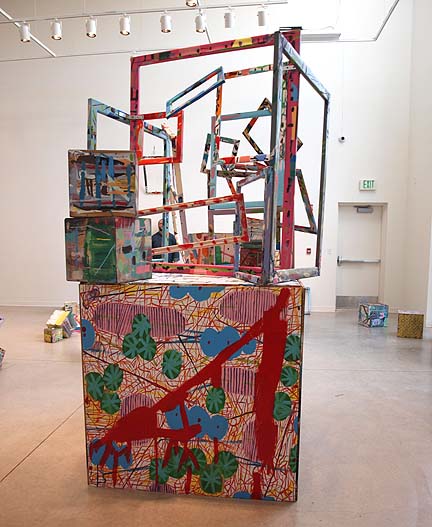
Despite a glut of group exhibitions at institutions for the past few months the most radical yet well executed show by a local artist has been Jesse Hayward's installation, The Kitchen Counter Collective at Linfield College's Gallery in McMinnville. It ends May 1st so this is your last chance. What's more the show even expands upon his highly successful exhibition in last year's TBA festival (where viewers could rearrange blocks that were also paintings), making this latest outing one of the strongest genre bending exhibitions of painting, sculpture and social interaction I've seen anywhere in recent years. Hayward began his art practice learning directly from Sol LeWitt and Karl Benjamin, so it's been a long road of experimental shows, which now seems fully developed. Considering this we should revisit the genres being blended: Painting has traditionally been a creature of expressed choice, put on display for the viewer showcasing the painter's decisions in; color, application method, support surface as well as the selection of subject… even if the subject is painting itself (as in Jackson Pollock). In traditional painting the artist celebrates the primacy of their decisions and there is a lot of emphasis put on authorship of the work. 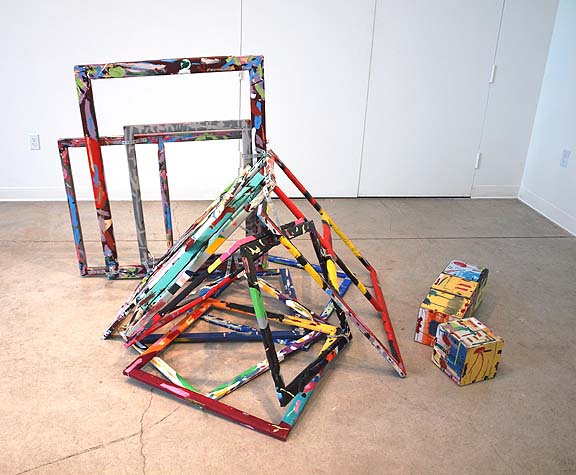
Whereas, sculpture has always been in the business of form and the ways it negates options of the viewer to explore by taking up available space as form. As an act of scarcifying the resource of space it's inherently more confrontational. Thus, it is presenting paths of relation or direction by removing some options. Sculpture is a compression of choice (aka a decision), whereas painting by being a more provisional and schematic art form is frequently a catalogue of choices, or "moves" if you want a softer term. 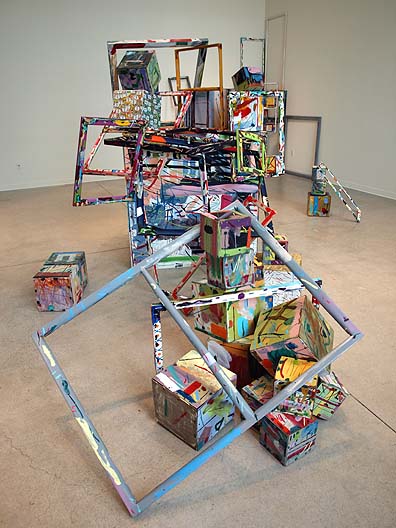
Generally speaking then there is something passive and generous about painting and confrontational and active about sculpture. Since the dynamic duo of Donald Judd and Dan Flavin we've been saddled with the realization that both genres can in fact be reconciled pretty effectively. For me Katherina Grosse is the top of my list of current practitioners but Jim Lambie is in there too. All of em, including Hayward are fond of rainbow colors. If the two venerated disciplines were parts of a restaurant the paintings could be thought of as the menu and sculpture as the table… let's leave the question of the actual art/food as something more difficult to pin down (as exemplified by Hayward's exhibition). 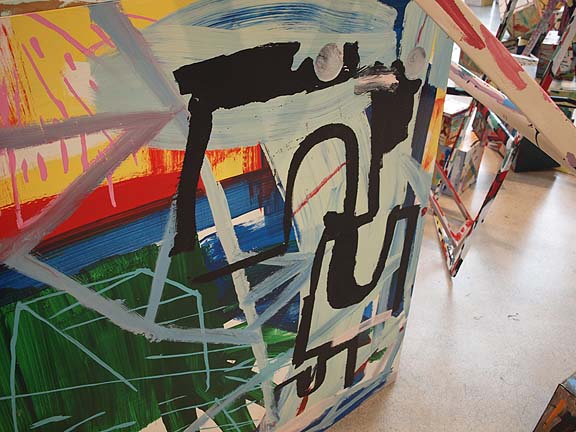
Overall, Jesse Hayward's work has inhabited and explored the space between wall/floor and viewer/artist for the past few years and it's telling that his version of the painting/sculpture restaurant is in fact being called a "kitchen counter." It's a question of agency and formality and by setting up such simple rules, "Be Safe, Make Art," Hayward allows the viewers to endlessly reconfigure the show. The net result is he's turned the art experience into a provisional delegation of composition back upon the viewer… and if they didn't get something out of the experience then the burden also falls somewhat on the viewer. That has always been the case but in this case it's a cleaner inversion, whereby Hayward has become the true spectator. He's even collecting security camera footage. Also, by delegating his agency of composition to others Hayward has knocked down the "wall" a lot of institutions have been seeking to blur, the art/viewer divide. It's sly because his paintings themselves (as raw material) have gotten a lot better… taking on a kind of Pierre Alechinsky (a comic book version of modern painting) meets LeWitt informality. Though visually satisfying the painting on the frames and boxes are there to psychologically encourage arbitrary decisions by viewers to re-site the work (the complete opposite of Judd and Flavin). 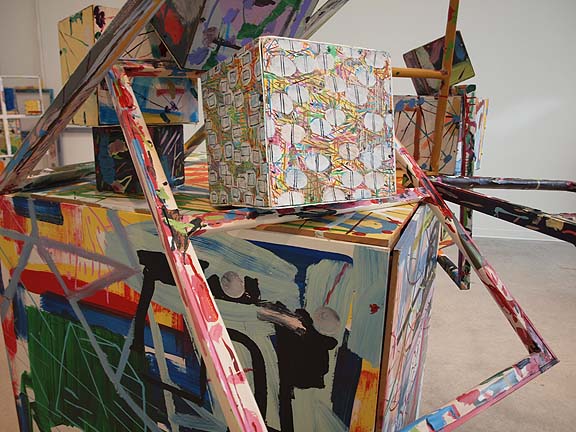
What is scary is how well it works, since the exhibition is full of completely satisfying aesthetic moments. Maybe everyone is an artist as long as there is an artist like Hayward who is willing to create work in support of the notion? Hayward is ultimately a bit more extreme but heavily indebted to Sol LeWitt (whom as child was lucky enough to work on a wall drawing for). What is more his show differs and considerably improves upon his TBA outing last fall since this time out the work exists in an institutional white box and not a classroom, which worked but riffed a lot on the romper-room motif. It was maybe too obvious a metaphor? Instead at Linfield the ideas feel like a more powerful institutional critique, where every painting is equal as is every visitor to the space. Incredibly democratic it allows for a manifold spatial experience reminding each viewer that they were in essence seeing (and creating) a different show in a nice demonstration of Heisenberg's Uncertainty Principle. This infinite interaction ultimately leads to all sorts of apocryphal stories like the two art students who worked together on one corner only to discover a springtime romance. Talk about manifold experience! 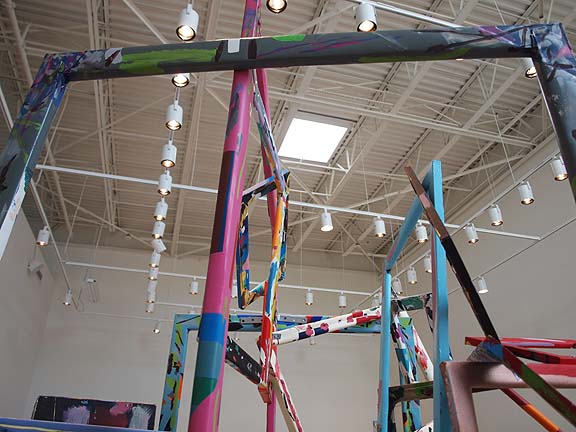
The show also differs from the TBA exhibition with the addition of a series of painted reconfigurable and often cantilevered stretcher bars and frames. It's metaphor for seeing and looking at the show of course as well as an institutional lens. Their presence balances the solid forms while making the whole affair more porous, while recursively evoking the whole painting/sculpture dialog again. An exhibition of infinite interaction, Hayward's The Kitchen Counter Collective may be one of the most effective college gallery art shows imaginable programmatically. Posted by Jeff Jahn on April 29, 2010 at 9:19 | Comments (0) Comments Post a comment Thanks for signing in, . Now you can comment. (sign out)
(If you haven't left a comment here before, you may need to be approved by
the site owner before your comment will appear. Until then, it won't appear
on the entry. Thanks for waiting.)
|
| s p o n s o r s |
 |
 |
 |
|
 |
|
 |
|
 |
|
 |
|
 |
|
 |
|
 |
|
 |
|
 |
|

|
Site Design: Jennifer Armbrust | • | Site Development: Philippe Blanc & Katherine Bovee | |