"There is no true way except for that which is true for oneself. My way does not invalidate the way of anyone else."
-Carl Andre in an interview with Paul Sutinen in 1980
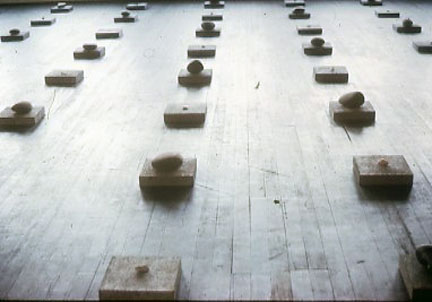
Carl Andre
144 Blocks & Stones, 1973 (Detail)
Concrete blocks, found and store bought rocks and minerals
Installed at the Portland Center for Visual Arts in March 1973
Image courtesy the PCVA Archive at the Portland Art Museum
(c) Carl Andre 2008
Here are ten questions that I asked Carl Andre about his installation 144 Blocks & Stones at the Portland Center for Visual Arts, March-February 1973.
In the early correspondence for the exhibition at the PCVA, the installation was described as a "scavenger" show. When did you decide to use river stones and concrete blocks for the installation?
When I arrived in Portland.
When you were looking for river stones, what qualities were you looking for? The found river stones were complemented by specific geological samples purchased from stores. How did you decide which samples to buy? Do you remember where you found the river stones?
I selected ones that interested me. I found them in the local river.
One of my friends that accompanied you for a week in 1970 said that you will always take beautiful side of a steel plate, or in this case a concrete block or river stone and place it face down. Why is that?
The purpose was to make the surfaces uniform.
The concrete blocks become like plinths that create the perfect pedestal for each of the stones but really work in the context of your other sculptures where the blocks might have been displayed by themselves. The concrete blocks provide a way of creating a common module that allow for the installation to exist as a grid while the individuality of each of the stone subverts the grid. Each module of the grid becomes unique. The specificity of the stones counteracts the negative space between the blocks. Was that the intention?
I don't really understand that. A grid is a grid is a grid.
How do you think that the blocks and stones work together to create a sense of place?
They work together because I put them together.
The installation alternates between larger and smaller stones, on the diagonal. How did you decide how the piece would be installed?
That's your personal interpretation. It had nothing to do with my intentions.
It is interesting that in a lot of your other work the units of the grid, except in the scatter pieces, almost always touch one another. I think that reinforces the idea of place. In the PCVA, you are allowed to walk around each stone and block almost as if they are separate sculptures. How do you think the work changes when you are looking at just one stone and concrete block vs. the field as a whole?
It is almost impossible to see one stone and block at one time.
Each block and stone were sold as a unit for $50 to benefit the PCVA's programming. What gave you the idea to sell each unit individually rather than the work as a whole?
It's easier to sell them unit by unit than as a whole. The price for the whole would have been too expensive.
How would you describe your experience and in Portland and has it had any lasting impact on your art?
I had a good time. I liked the food and the people and I would like to go back.
When I was going through the archive, I was sad to read a note of yours that talk about the death of Robert Smithson a few months after the exhibition in June of 1973. I read your note and it made feel like it was yesterday. In the catalog, you suggested adding an insert that dedicates the show to Smithson. It is strange that the installation, which implies the relocation of the landscape, could have almost been done by Robert Smithson, almost as a premonition. When I think a work by Andre, I think of the specific properties of the materials that you are working with, their arrangement and their ability to make a specific place. Beside Spiral Jetty, I always think of Smithson's work as dealing with general ideas about the relocation of the landscape while yours are specific. Would that be correct?
Robert Smithson is an artist I admired very much. I had not a single thought about him when I was in Portland.
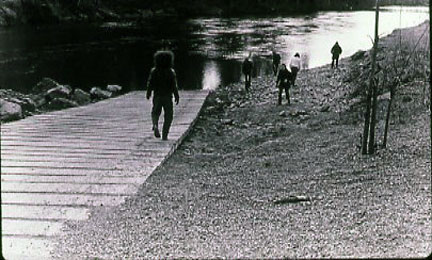
Looking for stones by a local river for the installation at PCVA
Image courtesy the PCVA Archive at the Portland Art Museum
OMG! This interview is too funny!
You should have interviewed the river stones, they might have had more to say.
I believe that is the point.
Had he rambled on like Terence Koh, I'd be worried.





![[TypeKey Profile Page]](http://www.portlandart.net/nav-commenters.gif)