|

|
|||
|
Portland art blog + news + exhibition reviews + galleries + contemporary northwest art
|
||||




Judy Cooke and Amanda Wojick at Elizabeth Leach Gallery 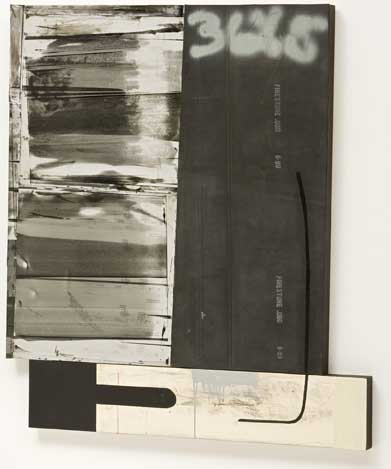 Judy Cooke, Oil, 2007 rubber, aluminum and oil on wood 43 x 38.5 x 2" Black Rubber has many connotations. Some of us might think tires, others its uses as a shock absorber/ dampener and others, well how should I say it, something more entertaining. According to Wikipedia, natural rubber is an elastic hydrocarbon polymer that naturally occurs as milky colloidal suspension, or latex, in the sap of some plants. In other words, rubber is a natural substance that has found lots of uses in industrial applications: tires, tubes, gaskets, etc. We use rubber to make sure our cars stay on the road and to make sure that when we connect to pipes that don't leak. Not to overstate the obvious but rubber is flexible, it adapts, it absorbs, it transforms itself according to the pressures that are exerted on it. This is why I was surprised to see it used in a raw, industrial material for Judy Cooke's Splits + Divisions at the Elizabeth Leach Gallery. 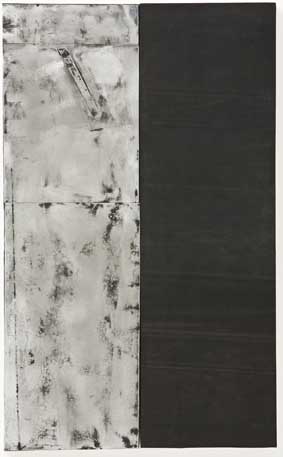 Judy Cooke Bolt, 2007,rubber, aluminum and oil on wood 36 x 22 x 2" When you take a close look at Bolt, you can see that both rubber and the aluminum sheets had other lives before they were joined. The aluminum plates look like the printing plates for hospital forms. The rubber was most likely some sort of the rubber inner tube. After having out lived there original purpose, they were probably discarded and might have been straight to the landfill. Bolt's materials work best when they are used in their semi-natural industrial state. The rubber still records the diagonal indentations left by an industrial press. The aluminum has been sanded to remove most of the text of the plate although you can still see bits and pieces if you look closely. The composition is a straight forward as the materials, a vertical line that cleaves the two materials. One side reflects light the other side, while the rubber absorbs light and we are caught somewhere in the middle in a post-industrial Barnett Newman. 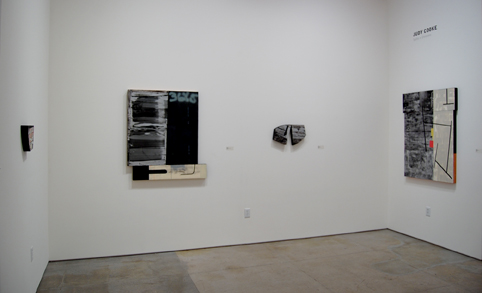 Installation view Cooke's new work is as rough and as straight forward as the materials that she uses. In Oil, you can see that the aluminum plates were attached to the frame with staples. The means of attachment are as direct as the materials. The aluminum plates are left with most of the text although they have been painted over with black paint probably to change the reflectivity of the aluminum but also to relate in to the rubber on the opposite side. The rubber is laid down so that it creates a dynamic diagonal that adds tension to the composition. You can still read the Firestone stamp that forms a broken line mid way across the rubber and of course, there is the spray painted text along the top of the panel "36X5." You get the feeling that Cooke is using industrial materials but she wants to accept it as art with a little intervention. She is willing to accept the natural characteristics of a material up to a point but it is important for her to craft her own solution. At the bottom of Oil where there is a black line that connects the upper aluminum panel and rubber panel to the lower offset painted panel, I was surprised to see that the black line which looks so natural was actually very carefully placed. You can see the slight indentations of the ridges of where the line was carefully taped, painted, the tape was removed and the line was painted over again. It reminded that everything in the composition was very carefully thought out and planned. Every step was deliberate. Things that look spontaneous but are actually carefully thought out have a precedent in the combines of Robert Rauschenberg. 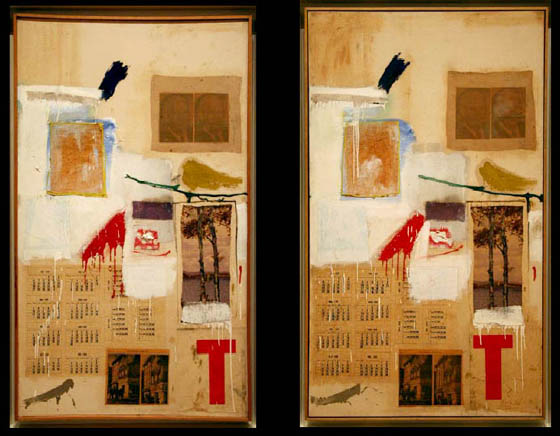
Rauschenberg's Factum I & II, 1957 In Rauschenberg's combines of the 1960's, the materials were were improbable and used in impossible ways to decipher, that is what makes them so good. You are never sure whether it was an accident or what was intentional. When you look at the combines, he is using every piece of trash, left over light or stuffed animal that he could get his hands on. To his credit, all of the raw materials that he used were transformed into something else in the final piece. They retained their identity and they became something more than what they were which is why they make such exceptional works of art. But as Factum I and Factum II clearly show, the spontaneity although it might not have been contrived, it was not really spontaneous either. Everything was planned and controlled just as much as it is in Cooke's work. Cooke's new work is a deep collaboration with industrial materials that society once had a use for and now has thrown away. The aluminum plates and the rubber give her new work a rougher quality than the plywood pieces. The overall feeling is more industrial and perhaps more important, it is harder to figure out what was intentional to her process and what was just part of the materials as she had found them. It is interesting that the more the materials are allowed to have their own voice and are allowed to keep their own character, the stronger Cooke's work becomes. 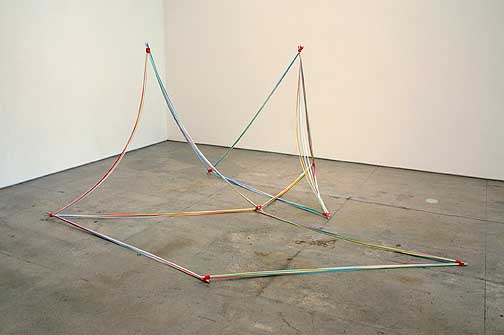 Amanda Wojick After, 2008, house paint on wood with rubber bands 134 x 128 x 58" In the front room of the Elizabeth Leach Gallery is Amanda Wojick's Sight Line show. My favorite work is After, which consists of bundles of multi-colored wooden dowels that are drawn together to create a series of interlocking tetrahedron like shapes. It was a nice idea to paint the dowels different colors because it gives each of the legs of the tetrahedron a randomness that makes the sculpture surprisingly painterly. Each leg of the tetrahedron looks like they are tightly bound with the rubber bands. The bands also allow each leg of the tetrahedron to extend beyond the connection point so that the viewer is very aware where each dowel starts and stops. The result is that each dowel retains its own identity while being part of a larger composition. 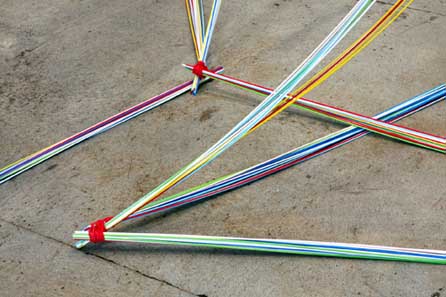 After (Detail) The fun part is when the bundles of naturally straight dowels begin to sag under the weight of gravity at the top of the each tetrahedron. Each of the bundles creates a shallow catenary curve as reaches toward the top. The sculpture becomes a collaboration with gravity. The curve reminds you of the fragility of the dowels individuality but at the same time its inherent strength when multiple dowels are bundled together. Each material that Wojick chooses to use is expressed naturally and directly. The result is not only playful but a very complex experience from very simple parts. Posted by Arcy Douglass on May 06, 2008 at 9:46 | Comments (1) Comments Probably Cooke's best outing since the fantastic tarp series of the mid 70's (but presented recently). I hope she expands these combination pieces to a similar range. Also using materials that reference the automobile and healthcare gives them a topical quality that might really take off if used in larger projects. On Wojick, I liked "After" the best as well... there's a bit of Mitzi Petereson (whom we saw just a few months ago in the same gallery) in there too. Would love to see an outright installation from Amanda some time. Posted by: Double J Post a comment Thanks for signing in, . Now you can comment. (sign out)
(If you haven't left a comment here before, you may need to be approved by
the site owner before your comment will appear. Until then, it won't appear
on the entry. Thanks for waiting.)
|
![[TypeKey Profile Page]](http://www.portlandart.net/nav-commenters.gif)
| s p o n s o r s |
 |
 |
 |
|
 |
|
 |
|
 |
|
 |
|
 |
|
 |
|
 |
|
 |
|
 |
|

|
Site Design: Jennifer Armbrust | • | Site Development: Philippe Blanc & Katherine Bovee | |